Master's thesis · Human–AI interaction · 2025–2026

Clone
Testing

A two-phase investigation of how people form, question and revise identity judgments while talking to humans and AI clones.

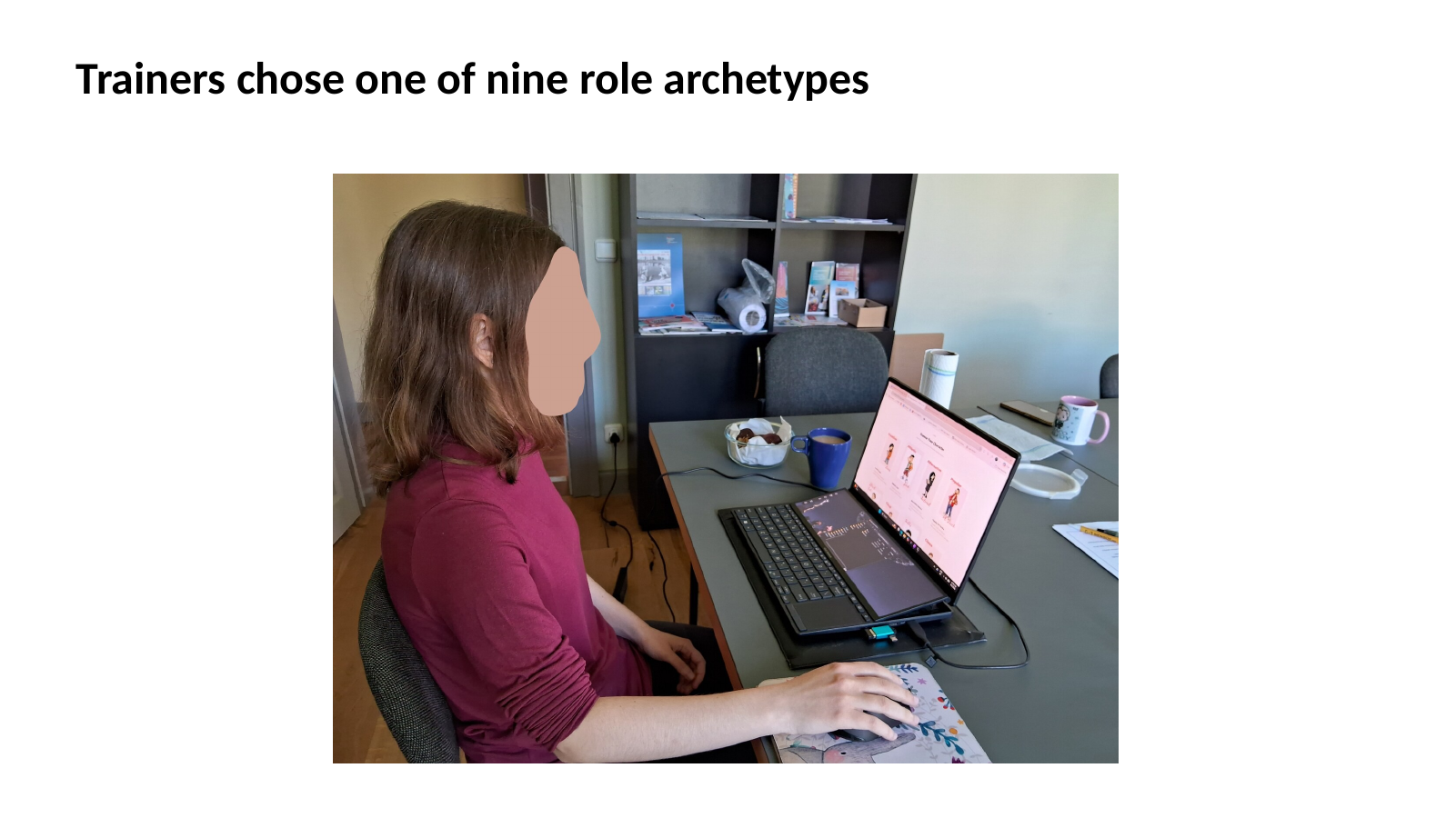
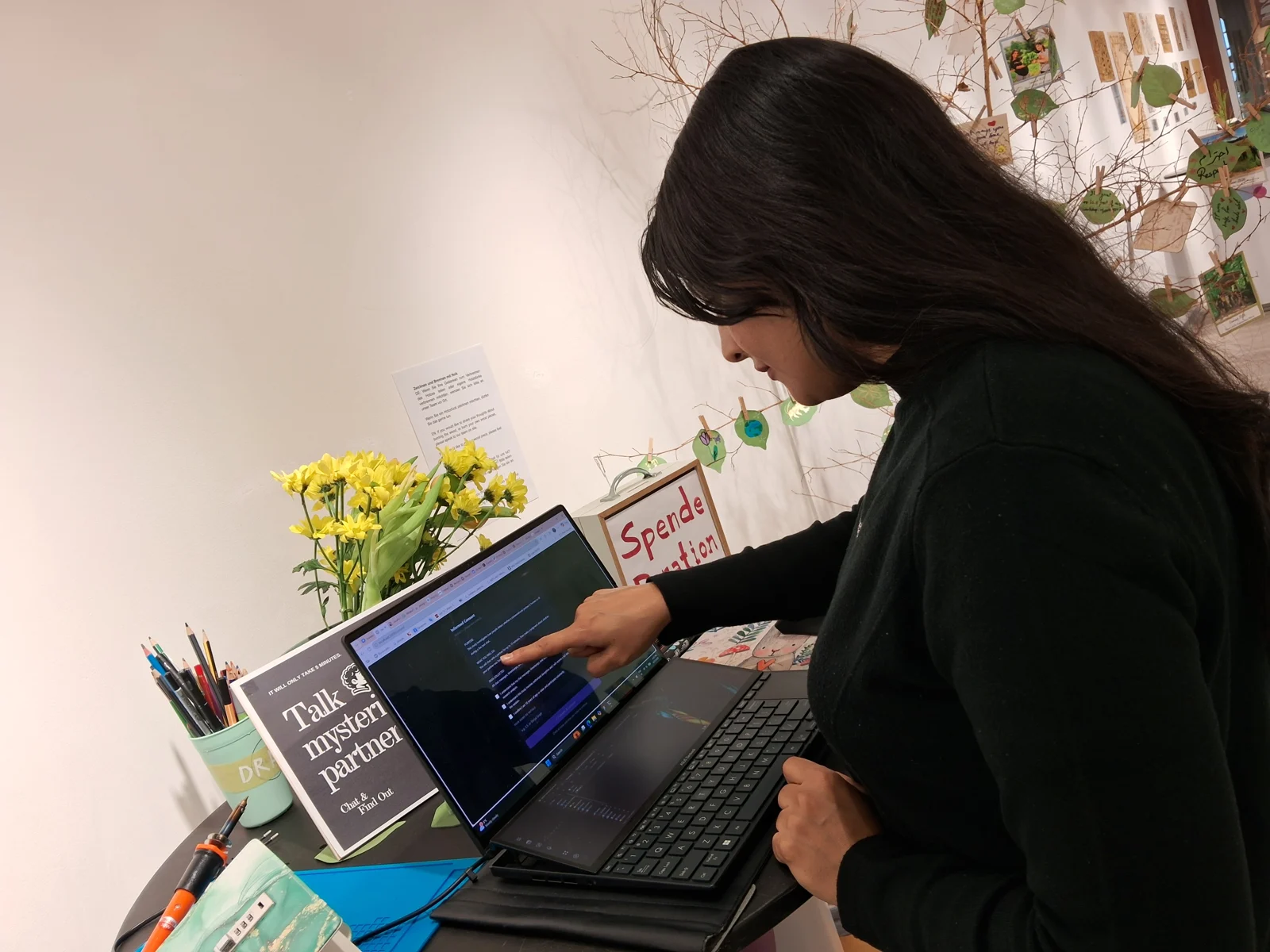
Participant using the Clone Testing study interface at a laptop
Talk with a mysterious partner. Then tell me what made you suspicious.
Research form Two-phase Turing-style study
Study participation 7 trainers · 10 evaluators
Phase 2 corpus 20 evaluated conversations
My role Researcher, system designer and facilitator

Beyond the final verdict

How do you decide who, or what, is speaking?

Most Turing-style studies foreground the final classification. I wanted to study the route toward that answer: the questions people use as probes, the responses that trigger suspicion, and the moments when later evidence reverses an earlier judgment.

Identity is not detected in a single sentence. It is negotiated across turns.

The work matters beyond a laboratory puzzle. As conversational systems become more socially capable, understanding how people accept, question and recover trust in an apparent identity becomes relevant to impersonation, manipulation and online safety.
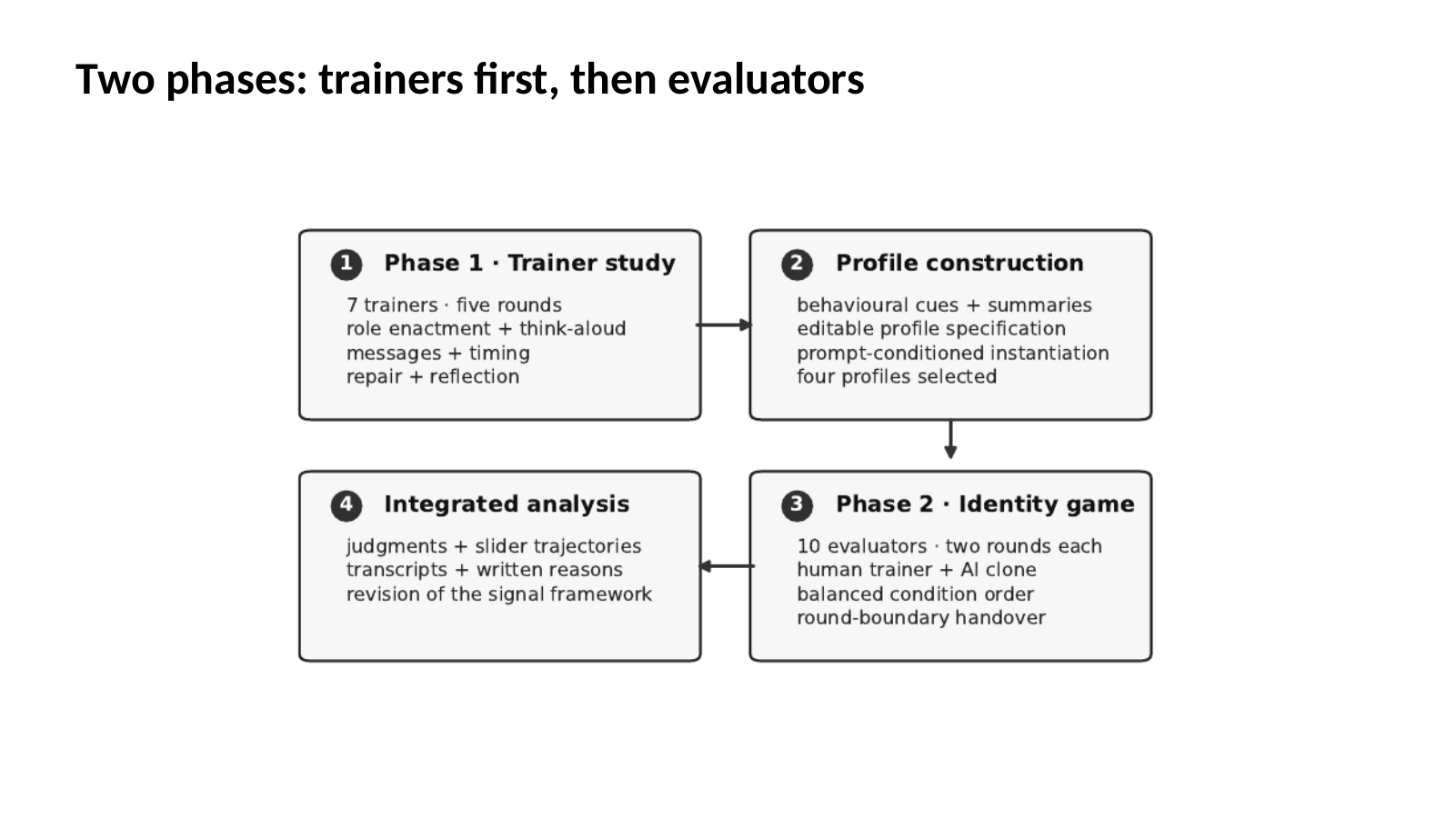
Elicit, construct, compare

Two phases made the clone traceable to a human source.

Rather than prompting generic personalities, I first studied people performing a role. Their conversational behavior then informed editable profiles for associated AI clones. A later evaluator study compared each clone with its source trainer.

Defence slide summarising the two-phase Clone Testing study from trainer sessions to evaluator comparisons
The full study at a glance: behavior was elicited first, then carried into a counterbalanced human–clone comparison.
PHASE 1

Train

Seven trainers role-played selected personas across repeated conversations, think-aloud sessions and retrospective interviews.

BETWEEN PHASES

Construct

Behavioral evidence became trainer-informed profiles. Trainers reviewed the profiles before deployment.

PHASE 2

Evaluate

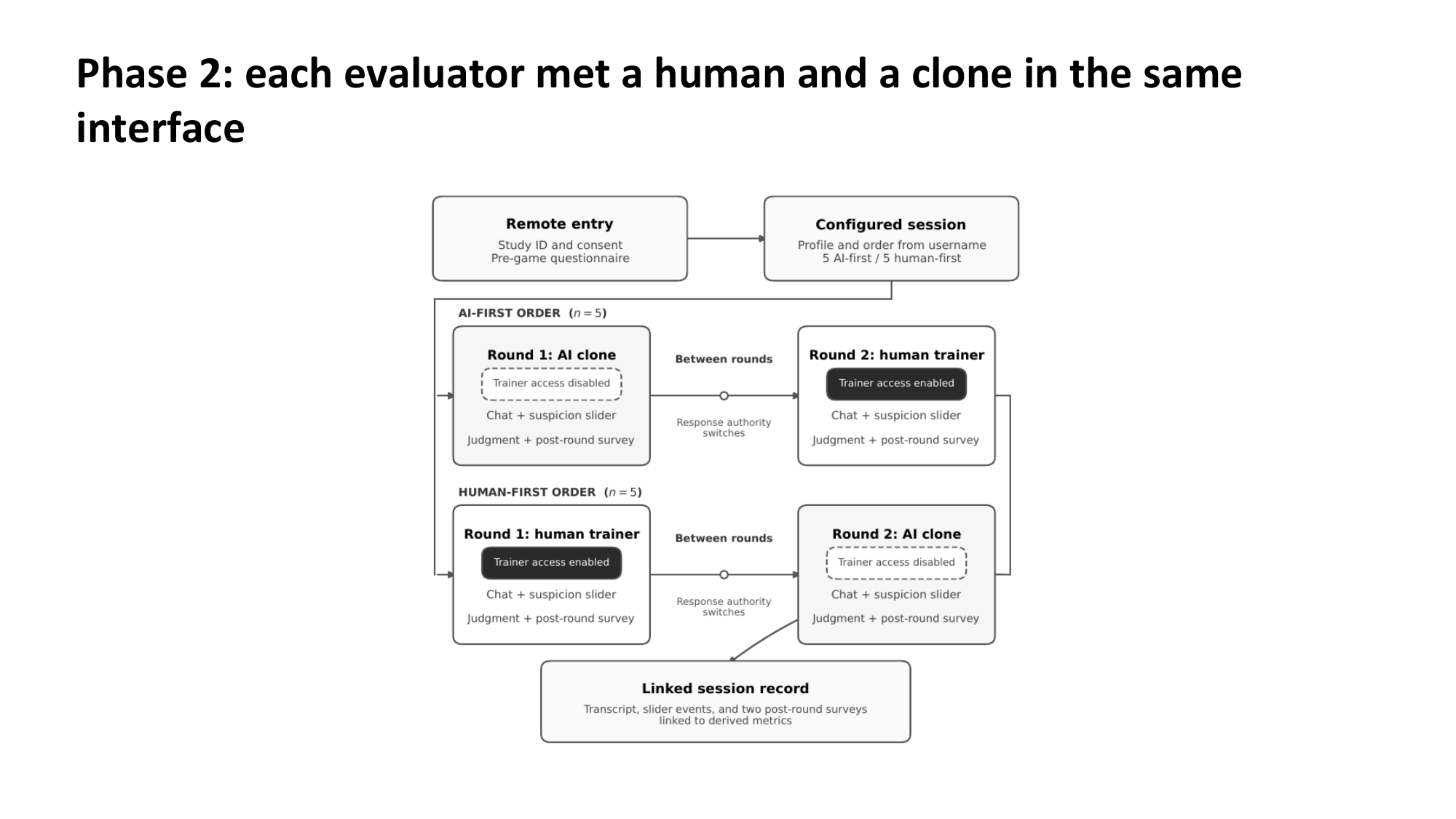
Ten independent evaluators spoke with a human trainer and an associated clone while recording suspicion during each exchange.

Defence slide diagram showing the counterbalanced Phase 2 study design, with evaluators meeting a human trainer and an AI clone in the same interface
The counterbalanced evaluator study, as presented during the thesis defence.
Defence slide documenting a trainer taking part in a Clone Testing persona session at a laptop
Phase 1 in practice: a trainer performing and reflecting on a conversational persona.

Observed behavior, then an editable profile

The clone was built from evidence—not a generic persona prompt.

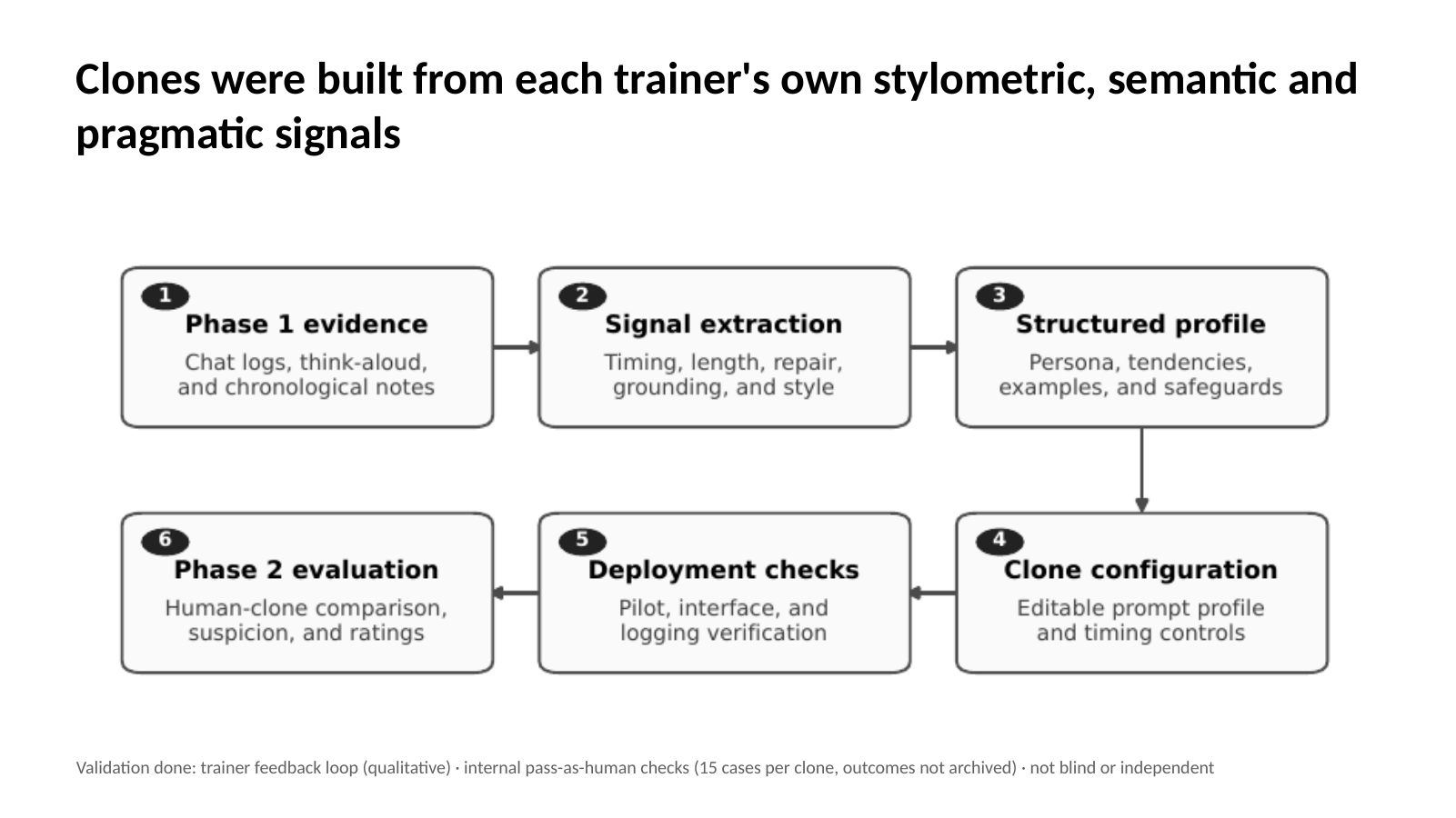
I translated repeated role-play conversations, think-aloud accounts and retrospective interviews into structured profiles. Trainers could review and correct those profiles before they were used in the evaluator study.

Defence slide showing how conversations, observations and interviews became a structured clone profile
The construction pipeline joined conversational evidence with trainer interpretation.
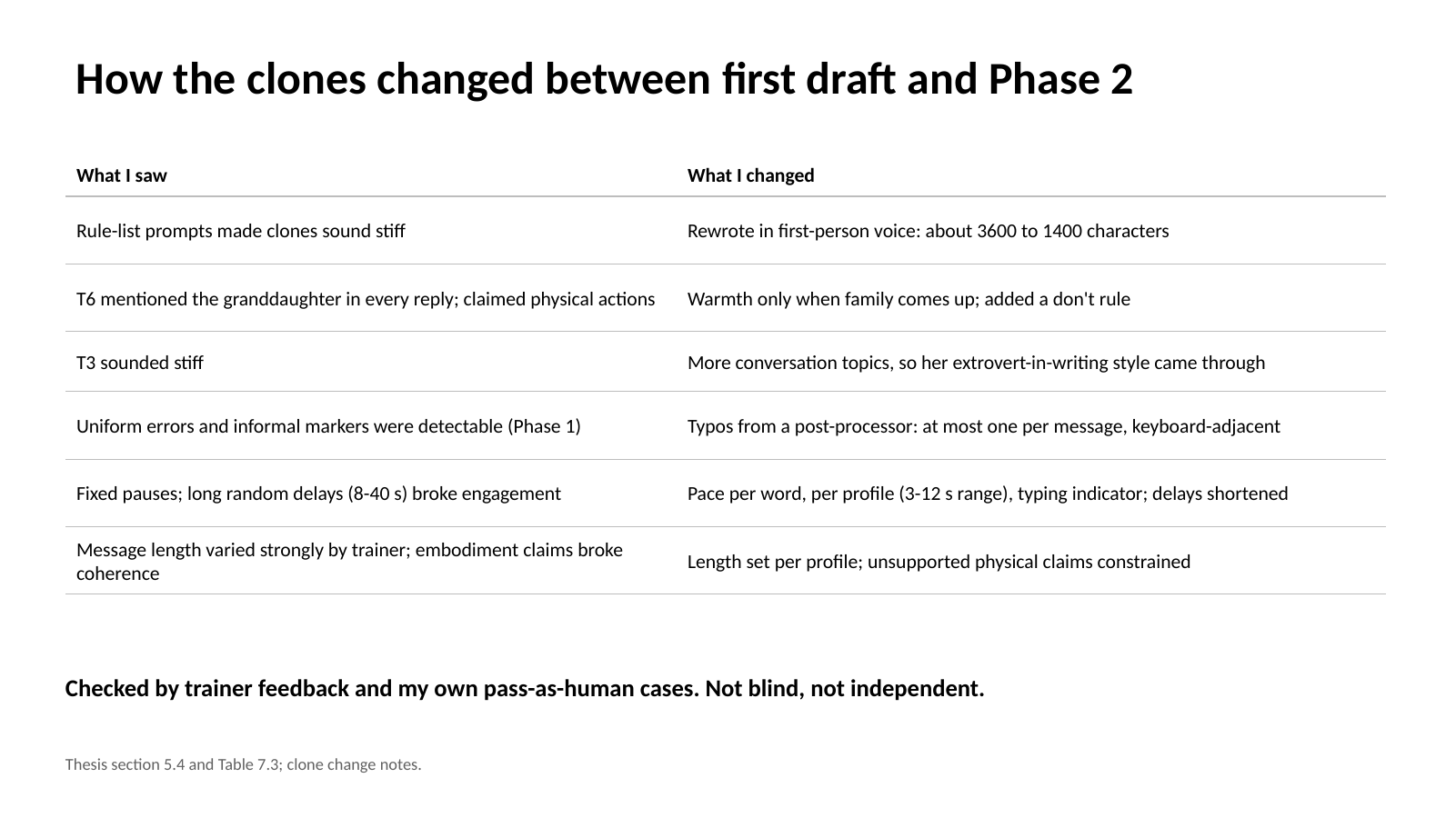
Defence slide showing the profile iteration process and decisions made after trainer feedback
Profiles were revised after feedback instead of being treated as a one-pass model output.

My contribution: I designed the elicitation protocol, facilitated the sessions, synthesized the profiles, built the web instrument and ran the evaluation. Trainer review improved fidelity, but it was not a blind or independent validation—a limitation carried into the interpretation.

A controlled encounter

The participant saw one conversation. The study system managed two possible partners.

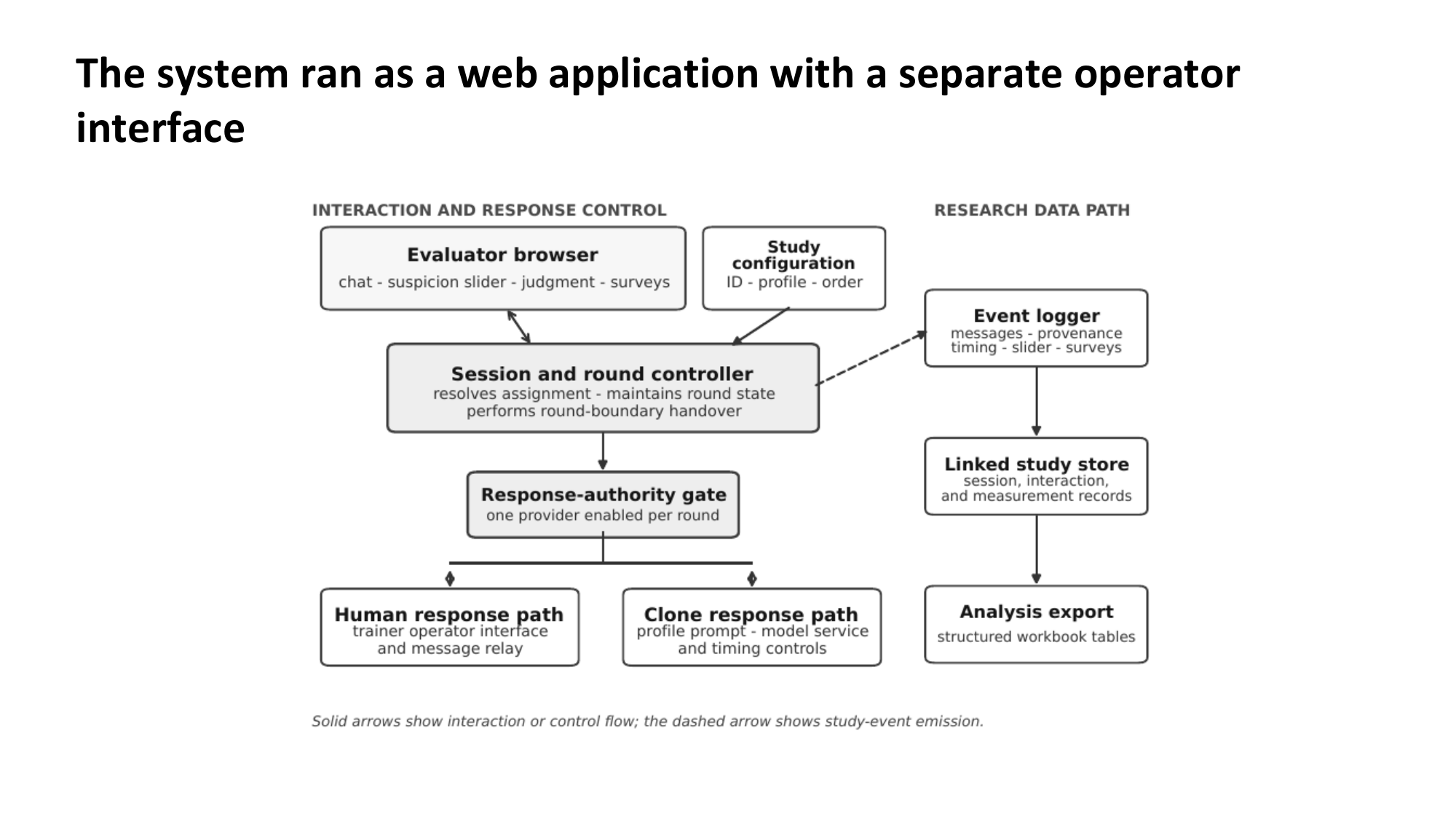
I designed a browser-based experimental platform with separate participant and session-control interfaces. A response router allowed the controller to direct a round either to the authorized AI model or to the associated human trainer, while keeping the evaluator-facing experience stable.

Defence slide showing the Clone Testing web application, response controller and linked research data path
The deployed system and its separate human and clone response paths.
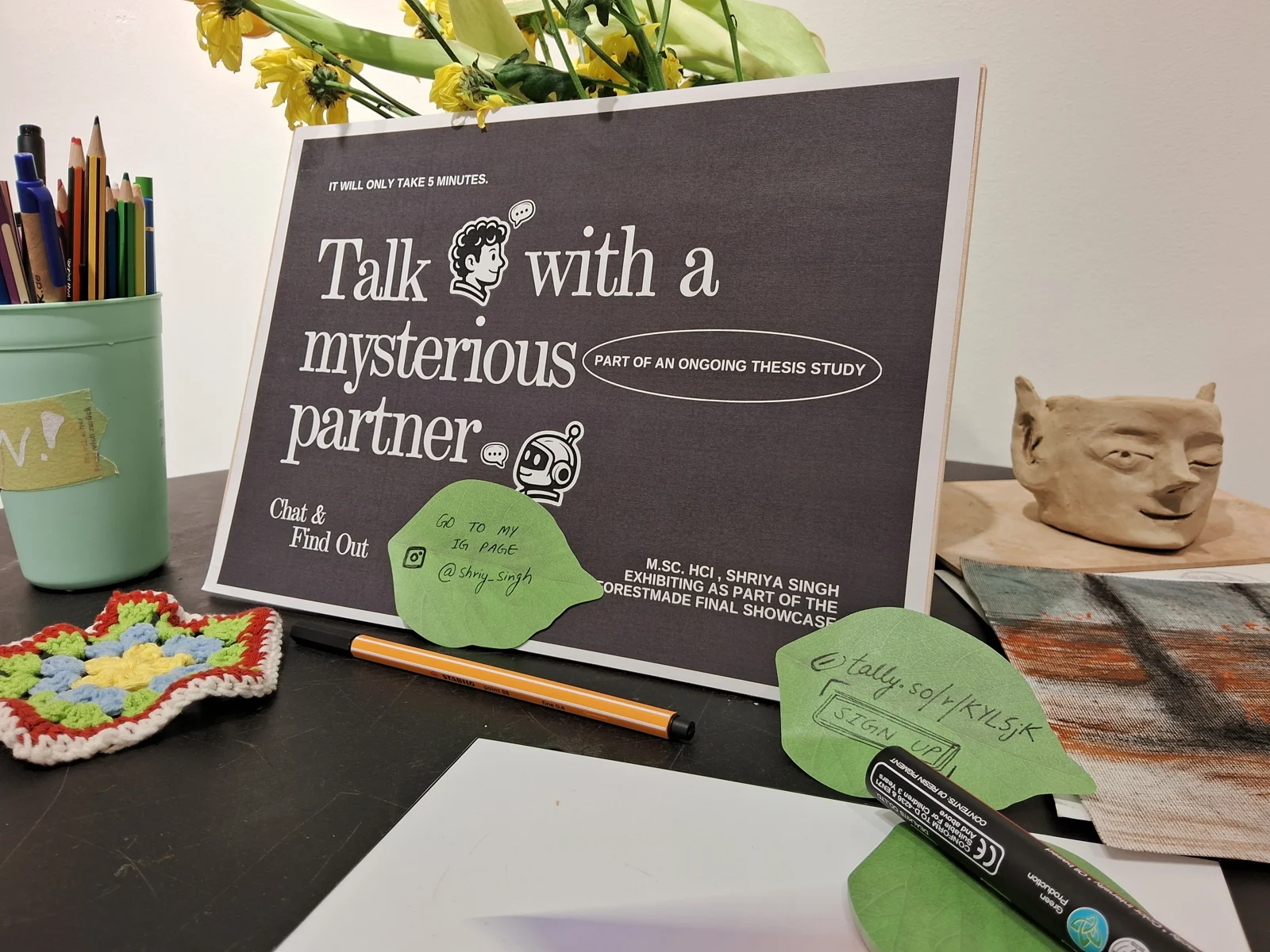
Physical Talk with a mysterious partner invitation used during the study
The public-facing study invitation and physical setting.

The research instrument is still live

Enter the deployed study system.

The prototype opens on the Webis research infrastructure. It preserves the interface used for the study.

PASSWORD: admin-password
Open prototype

The deployed instrument in use

A complete conversation round, preserved on screen.

This recording shows the evaluator-facing interface, the evolving conversation and the suspicion controls used during the study.

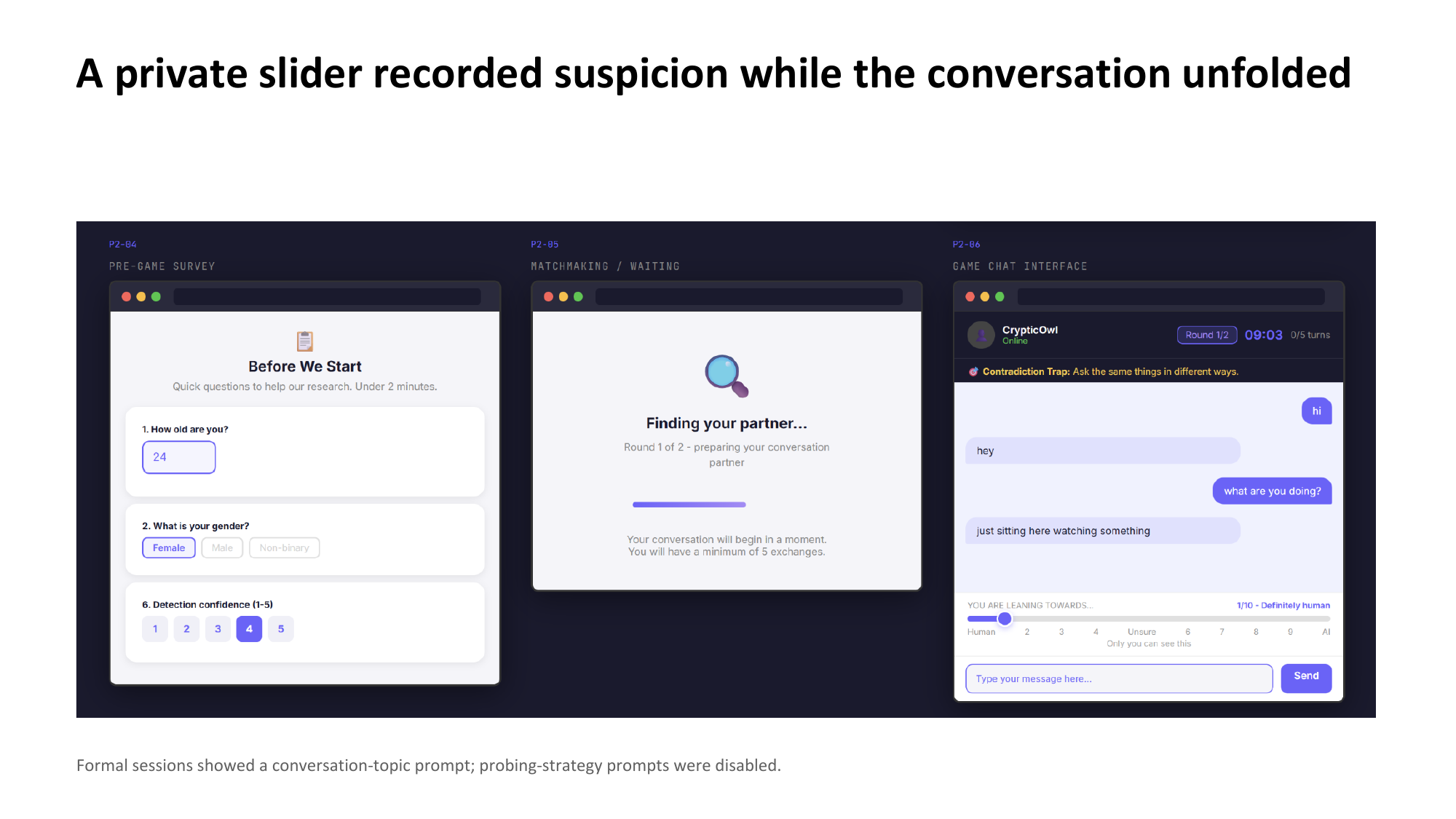
Defence slide showing the evaluator survey, matchmaking screen and conversation interface with a private suspicion slider
The evaluator journey shown together: pre-game questions, matchmaking and the conversation interface.
The Clone Testing prototype during an evaluator session.

Results from this study

People reached the right answer, but not in a straight line.

19/20

conversations were correctly classified by the evaluators in this small study.

332messages across the evaluated corpus
131suspicion-slider submissions
4.5 / 3.5human vs clone perceived realism, out of five
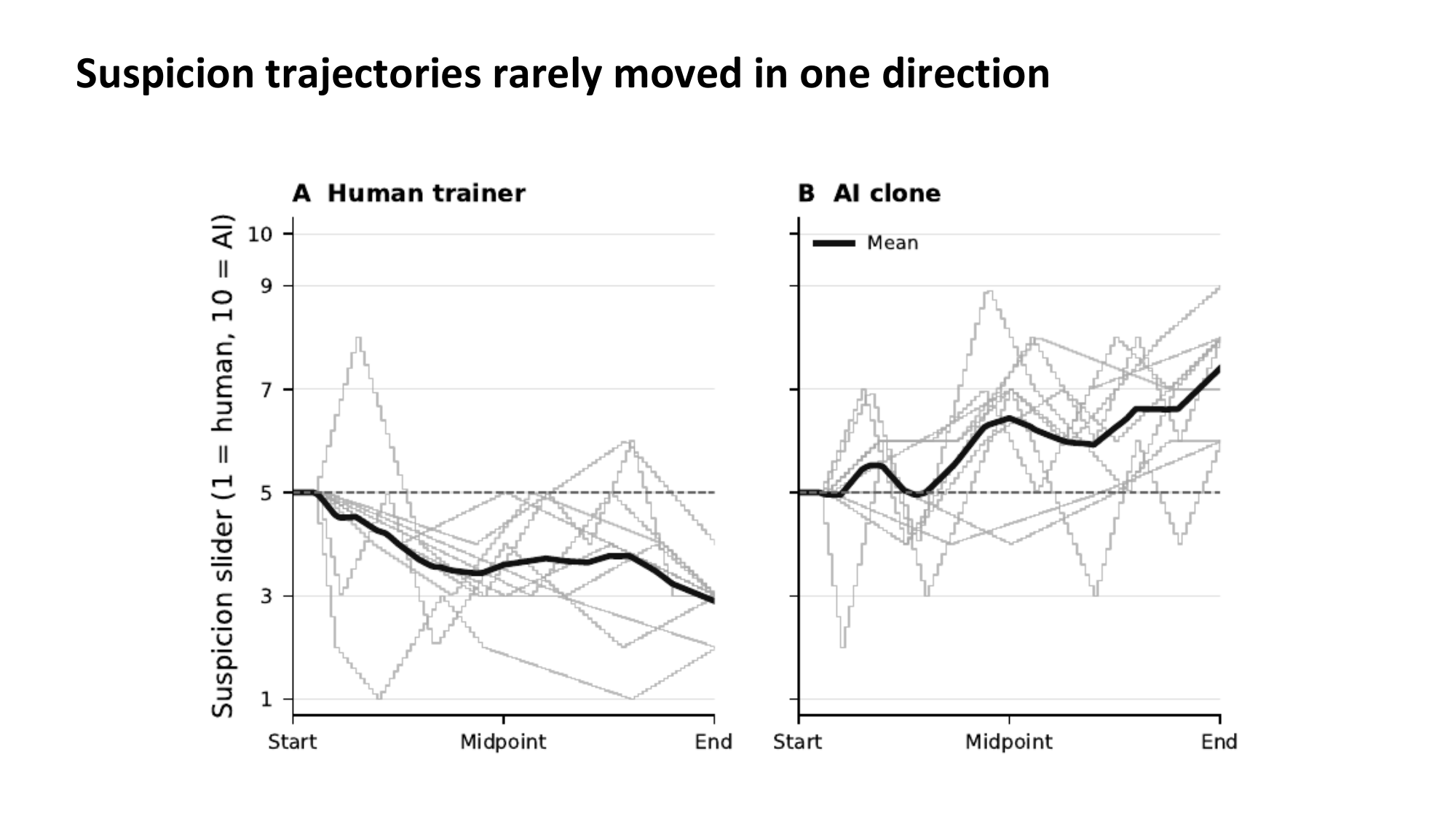
2.9 / 7.4human vs clone final suspicion, out of ten

Suspicion trajectories often reversed before the final judgment. A response could temporarily make a clone seem more human, while the same style of response became suspicious when its regularity accumulated across turns.

Defence slide comparing suspicion trajectories for human trainers and AI clones
Individual suspicion trajectories and condition means. The scale runs from 1, more human, to 10, more AI.
SIGNAL 01

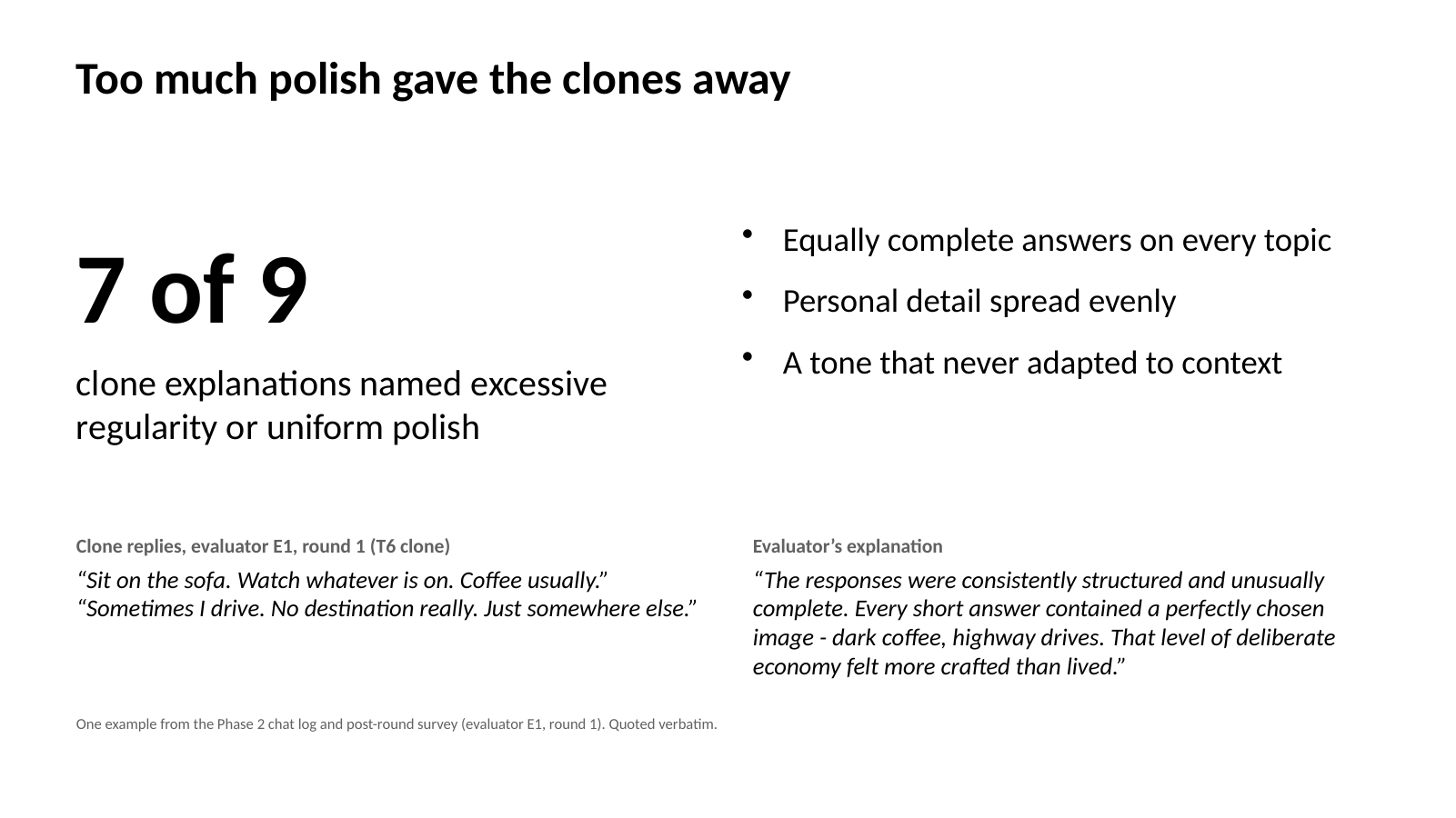
Excessive regularity

Consistency helped sustain a persona, but repeatedly polished structure could expose its artificial construction.

SIGNAL 02

Weak adaptation

Evaluators noticed when an answer did not respond convincingly to the immediate conversational context.

SIGNAL 03

Relational evidence

No cue worked alone. People interpreted timing, detail, language and reciprocity in relation to previous turns.

Defence slide explaining how overly polished responses made clones more detectable
Too much polish could become evidence of artificiality.
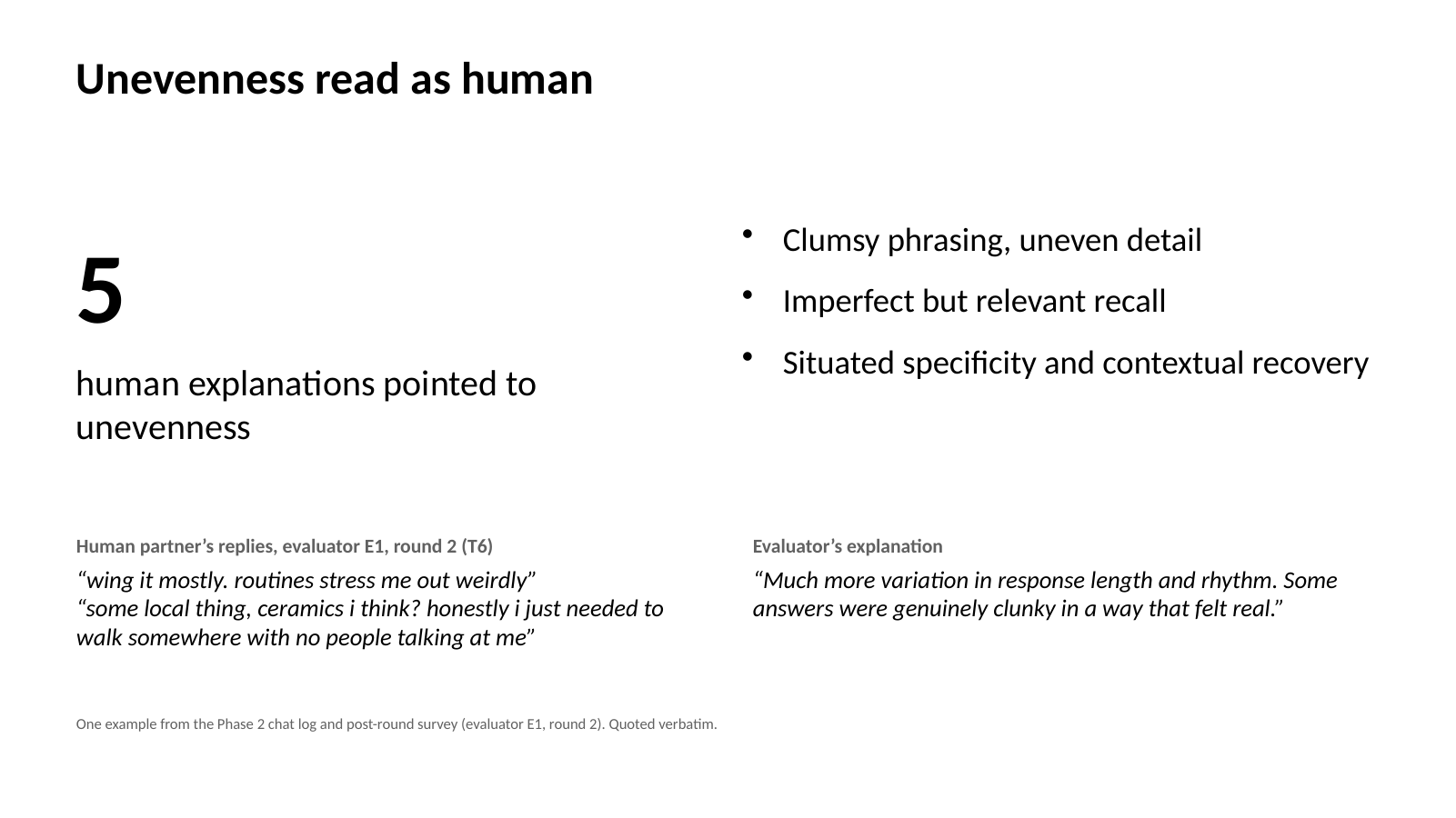
Defence slide explaining how uneven conversational behavior could be interpreted as human
Human messiness sometimes increased credibility.
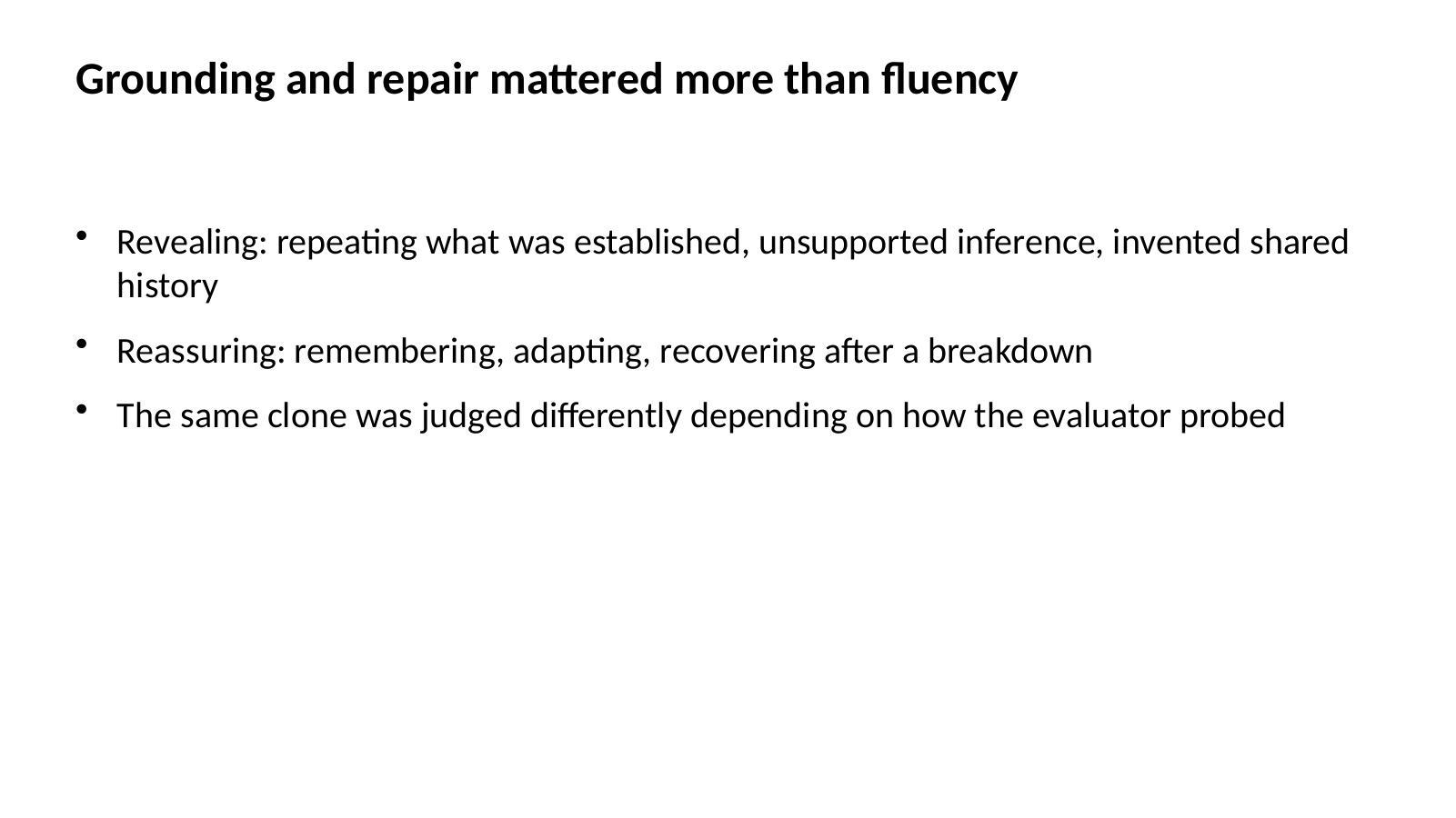
Defence slide identifying grounding and conversational repair as more important than fluency
Grounding and repair mattered more than fluent phrasing alone.
How to read this result

The 19-of-20 outcome belongs to this study, its participants, profiles and system. It is not a general AI-detection rate. The more important finding is how judgments moved, recovered and accumulated during interaction.

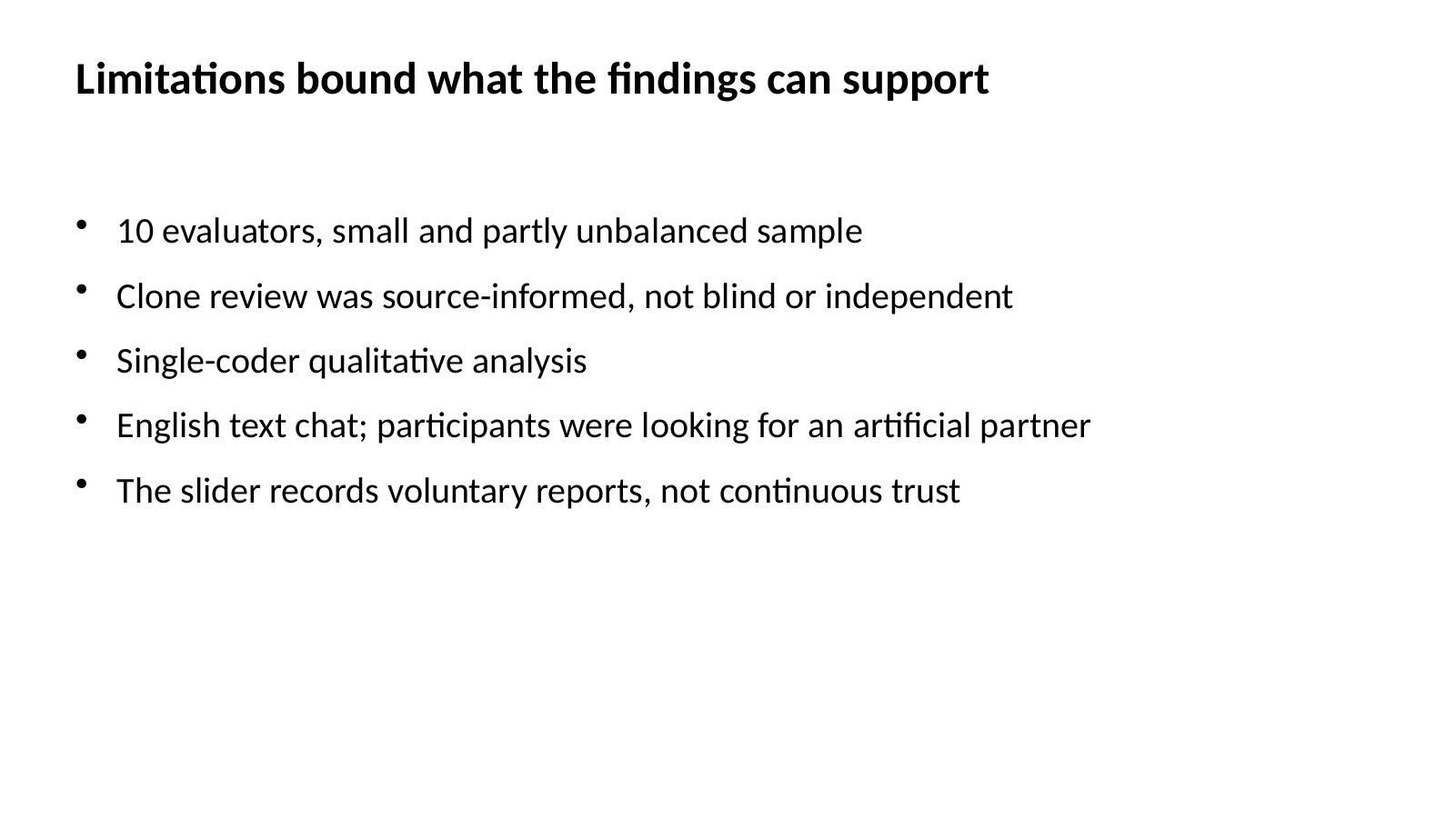
What the study cannot claim

A strong result in a deliberately small, situated experiment.

The study was designed to reveal how judgments developed—not to benchmark a universal detector. The profiles, roles, participants and interface all shaped what evaluators encountered.

Small, specific sample

Seven trainers and ten evaluators support close analysis, not population-level generalization.

Trainer-reviewed profiles

Review improved face validity, but it was not blind or independent profile validation.

Text-only interaction

The experiment did not test voice, embodiment or other modalities that may alter identity judgments.

One experimental setting

Familiarity with AI and the explicit study context may have encouraged active suspicion.

Defence slide listing the methodological limitations of the Clone Testing study
The limitations presented in the final thesis defence.

From cues to trajectories

A final label hides the most interesting part of the encounter.

The thesis reframes conversational identity judgment as a developing process. It contributes a two-phase method for building trainer-informed clones, a longitudinal way to capture suspicion, and an empirical revision of the Conversational Signal Table used to organize cues across turns.

METHOD

Behavioral elicitation

Profiles were grounded in observed role-play behavior rather than only in researcher-written persona descriptions.

MEASURE

Suspicion trajectories

A continuous record preserved changes in judgment that a final classification would erase.

INTERPRETATION

Conversation as evidence

Signals became meaningful through accumulation, contrast and conversational repair.