Tangible interaction · Pervasive computing · 2025

Mudra
Mor

What if a message arrived as a feather opening?

A near-zero-touch communication device that turns a quiet gesture into a moving peacock-feather display.

INPUT BECOMES MOTION
Interaction Place, touch, stroke or blow
Communication ESP-NOW wireless network
Output Two servo-driven feather fans
My role Concept, prototyping and electronics

Communication at the edge of attention

A notification does not always need a screen, sound or sentence.

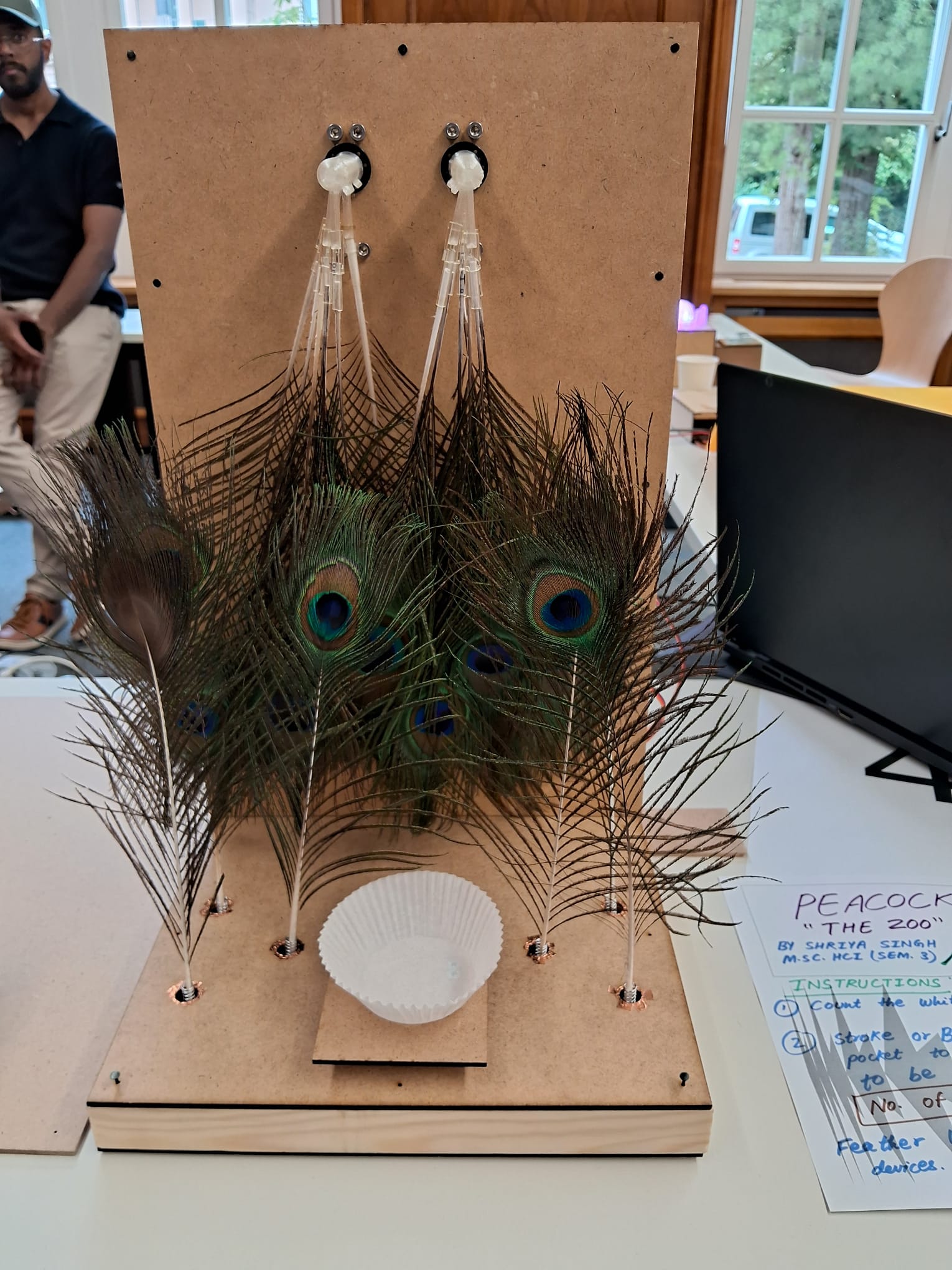
MudraMor explores a quieter form of networked communication. The sender chooses a recipient, gives the message an intensity, and completes a circuit with a light feather gesture. At the other end, peacock feathers open into a physical display.

The message is not shown. It is performed.

01 · CALM

Peripheral, not demanding

The output can be noticed without interrupting the receiver with a conventional alert.

02 · EMBODIED

Meaning through material

Weight, touch, motion and feather resistance become part of the interaction language.

03 · EXPRESSIVE

Intensity without text

The number of activated spring pockets changes how widely the feather fan opens.
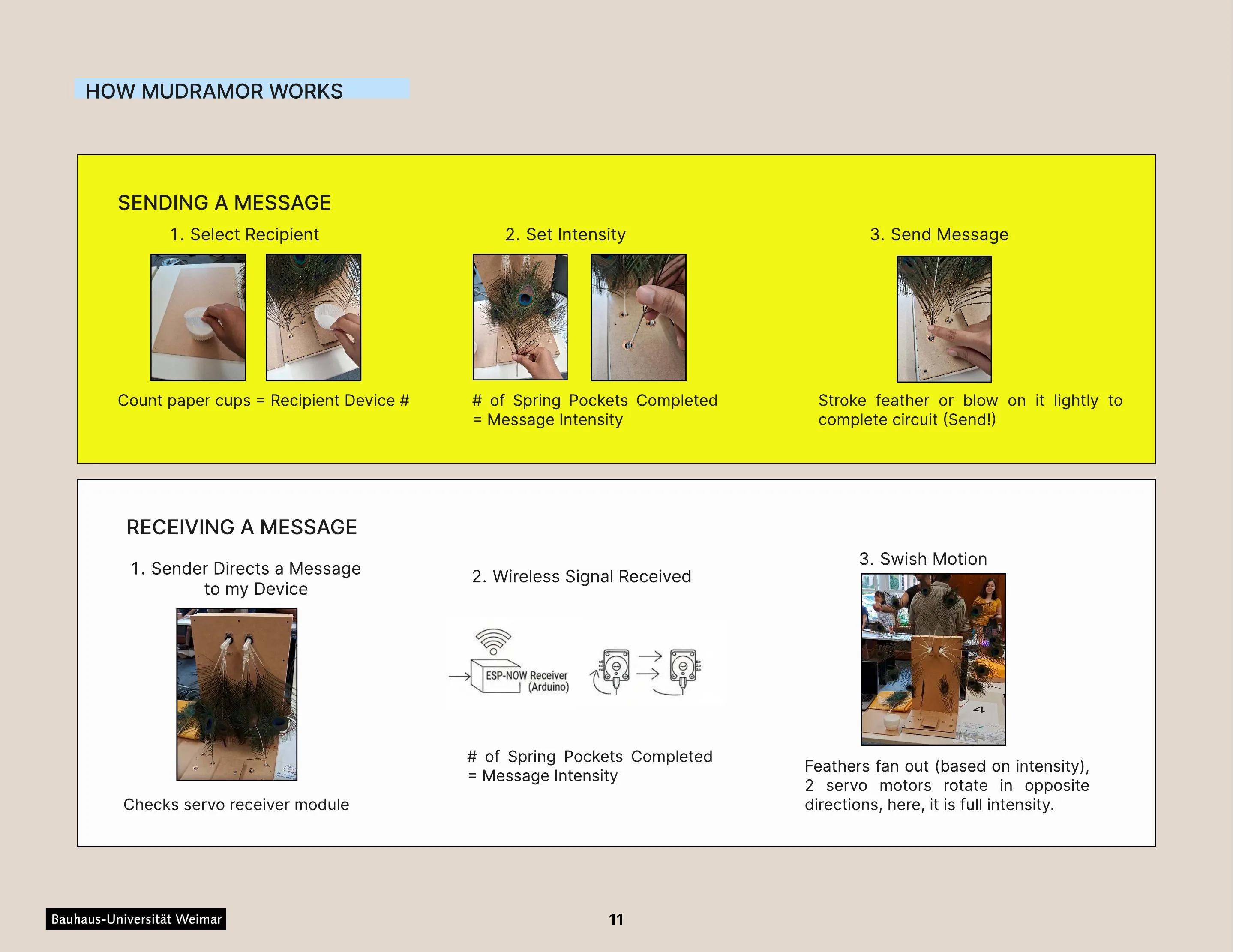
Three actions to send

Choose who, decide how much, then let the feather close the circuit.

STEP 01

Select

Paper cups map to recipients.

A load cell and HX711 read the cup weight range and route the message to the corresponding device.

STEP 02

Compose

Spring pockets encode intensity.

Completing more spring contacts builds a stronger message and later produces a wider fan movement.

STEP 03

Send

A feather gesture completes the circuit.

Stroking or lightly blowing the feather triggers transmission without requiring a button or screen.

Original MudraMor storyboard showing the sending and receiving interaction
The original documented interaction flow from sender input to the receiver's swish motion.

A distributed physical interface

Input, addressing and movement became one networked object.

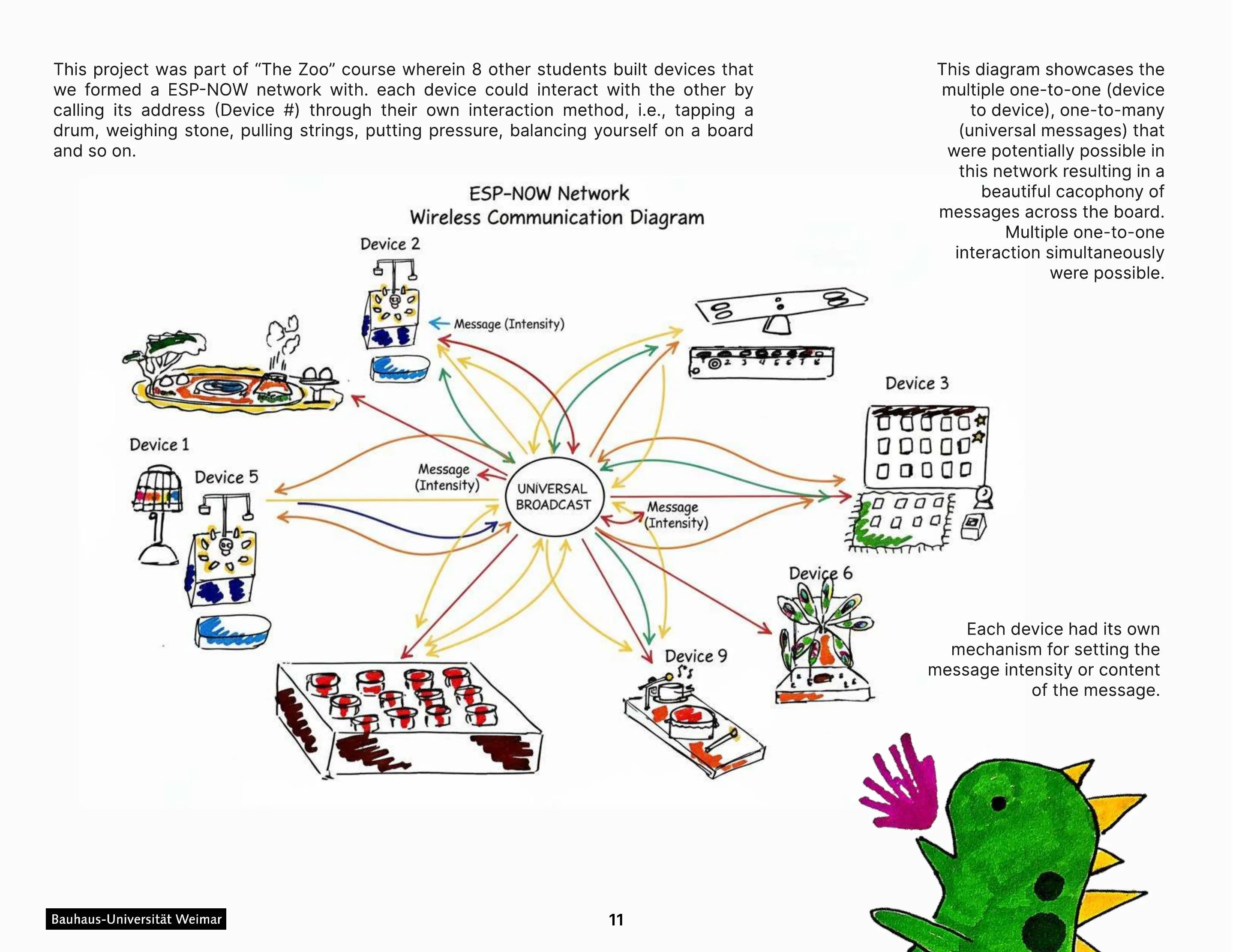
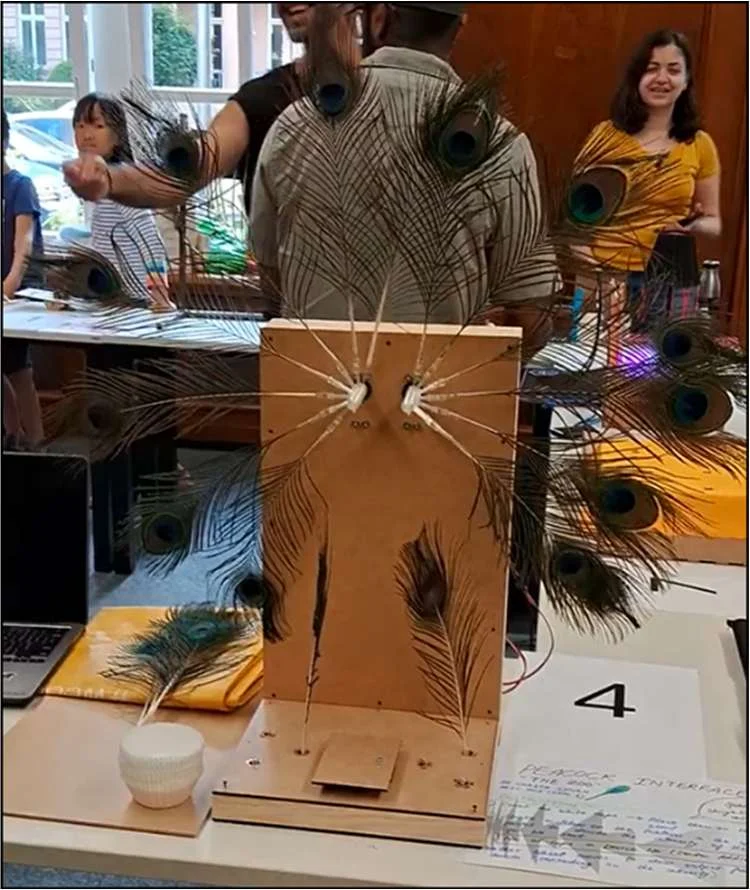
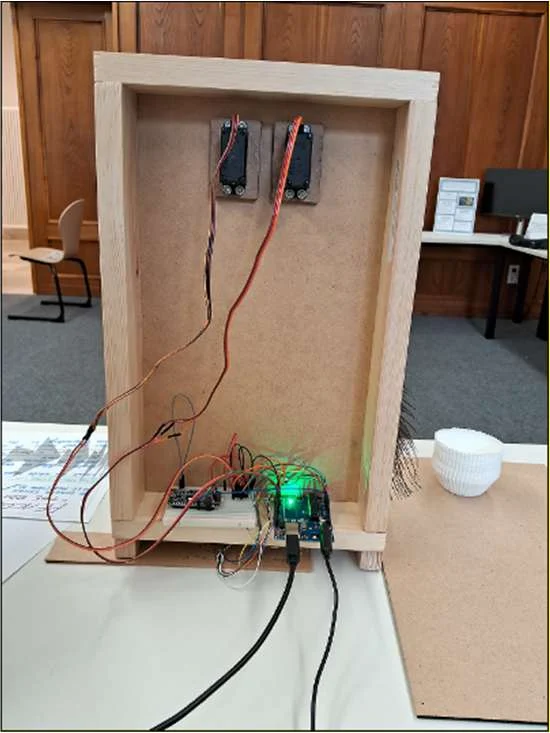
An Arduino-compatible controller translates physical signals into a small message packet. ESP-NOW sends it directly to the receiving device, where two servos rotate in opposite directions to open the feather display.

INPUT

Load and contact

HX711 weight sensing identifies the receiver. Spring-wire pockets represent intensity. A feather contact triggers dispatch.

NETWORK

ESP-NOW

A lightweight device-to-device protocol carries the recipient and intensity without requiring a Wi-Fi network.

OUTPUT

Opposed servos

Two feather assemblies rotate away from one another. Their angle maps the received intensity into a visible gesture.

MudraMor wireless communication and component architecture
The distributed communication diagram and the physical modules around it.

Fabrication as interface design

The interaction only became believable when the mechanics, electronics and material agreed.

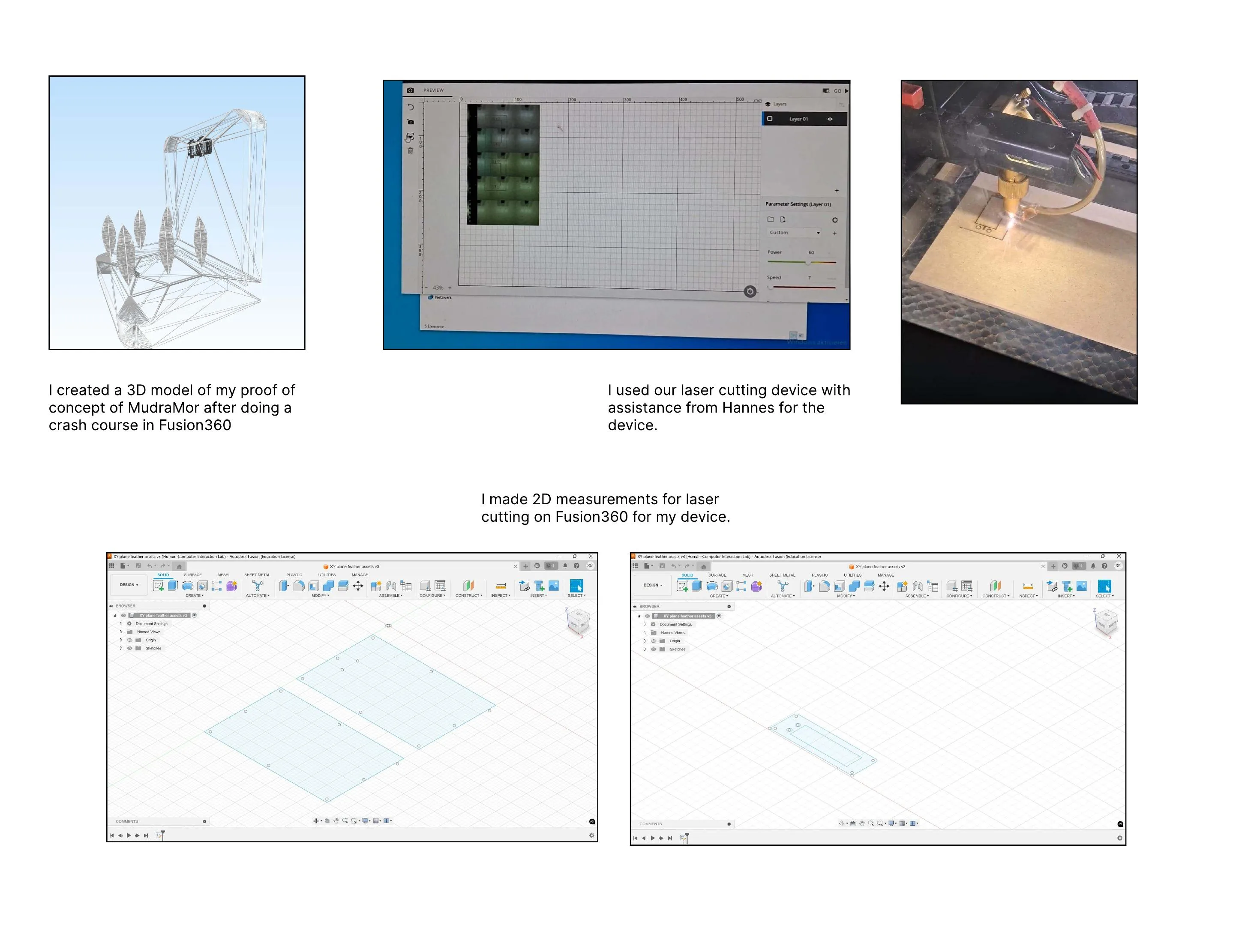
The system combined Arduino development, a load cell with HX711, ESP-NOW, servo control, Fusion 360, 3D printing, laser cutting and repeated physical calibration. The wooden housing and feather linkages were not presentation shells. They determined whether the gesture could work.

MudraMor sketches, component layouts and early prototypes
Sketching the input mechanism, enclosure and transmission logic.
MudraMor CAD, fabrication and electronics documentation
CAD, laser-cut parts, electronics tests and the assembled housing.

The prototype behaving as an interface

The movement makes the system understandable.

These recordings show how the prototype was used and how the receiving mechanism translated a message into feather movement.

Using MudraMor from the sender side.
The receiving mechanism turning a message into movement.
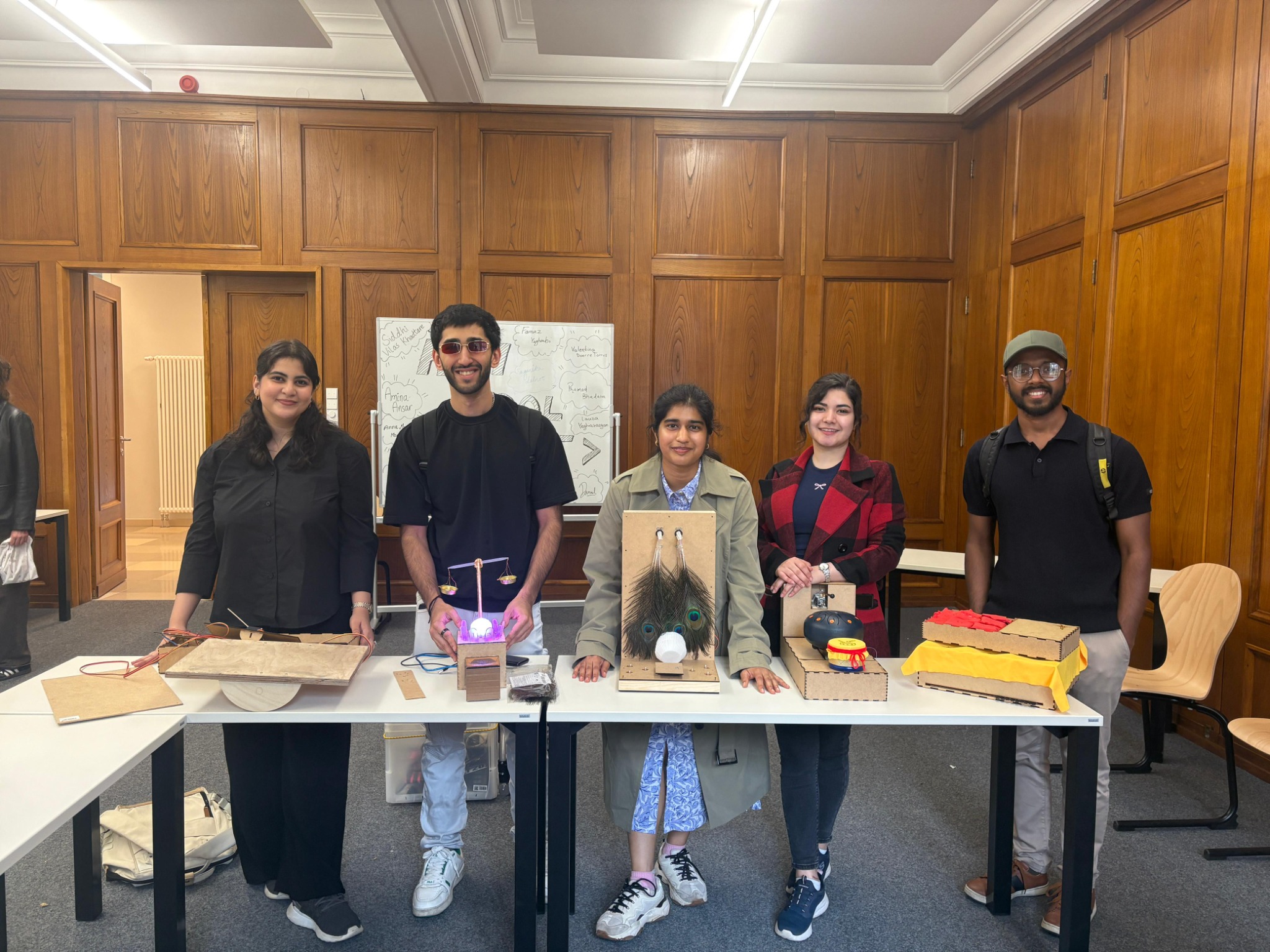
MudraMor working in the shared exhibition setting.

What the prototype taught me

Delicate interaction required surprisingly stubborn engineering.

Feathers are visually expressive because they are light. That same quality made them technically difficult. They did not register reliably on the load cell without added material, while servo alignment, fragile prints and inaccurate tube fittings repeatedly changed the mechanical design.

What held together

A complete end-to-end interaction

  • Recipient selection through calibrated weight ranges
  • Message intensity through spring contacts
  • Device-to-device ESP-NOW transmission
  • Opposed servo movement creating a fan gesture
  • A culturally grounded material identity

What I would change

Earlier mechanical integration

  • Prototype servo linkages before final fabrication
  • Test materials before committing to enclosure dimensions
  • Design the addressing protocol earlier
  • Use stronger, more adjustable printed parts
  • Evaluate comprehension and emotional interpretation with participants

Complete documentation

Read the project as it was submitted.

The report includes the theoretical framing, interaction paradigms, related work, electronics, code, fabrication, failed ideas and reflective account.

Open full report
A feather can be an input, an output, a signal and a small piece of theatre.

MudraMor sits between calm computing, tangible interaction and culturally situated design. It is less interested in replacing a phone than in asking what communication can feel like when computation moves back into the material world.