Ubiquitous computing · Product vision · 2025

NeuroBi

Support embedded in the journey, not hidden behind another portal.

A speculative network of situated kiosks, private wearable audio and mobile AR guidance for international students navigating their first 48 hours in an unfamiliar university and city.

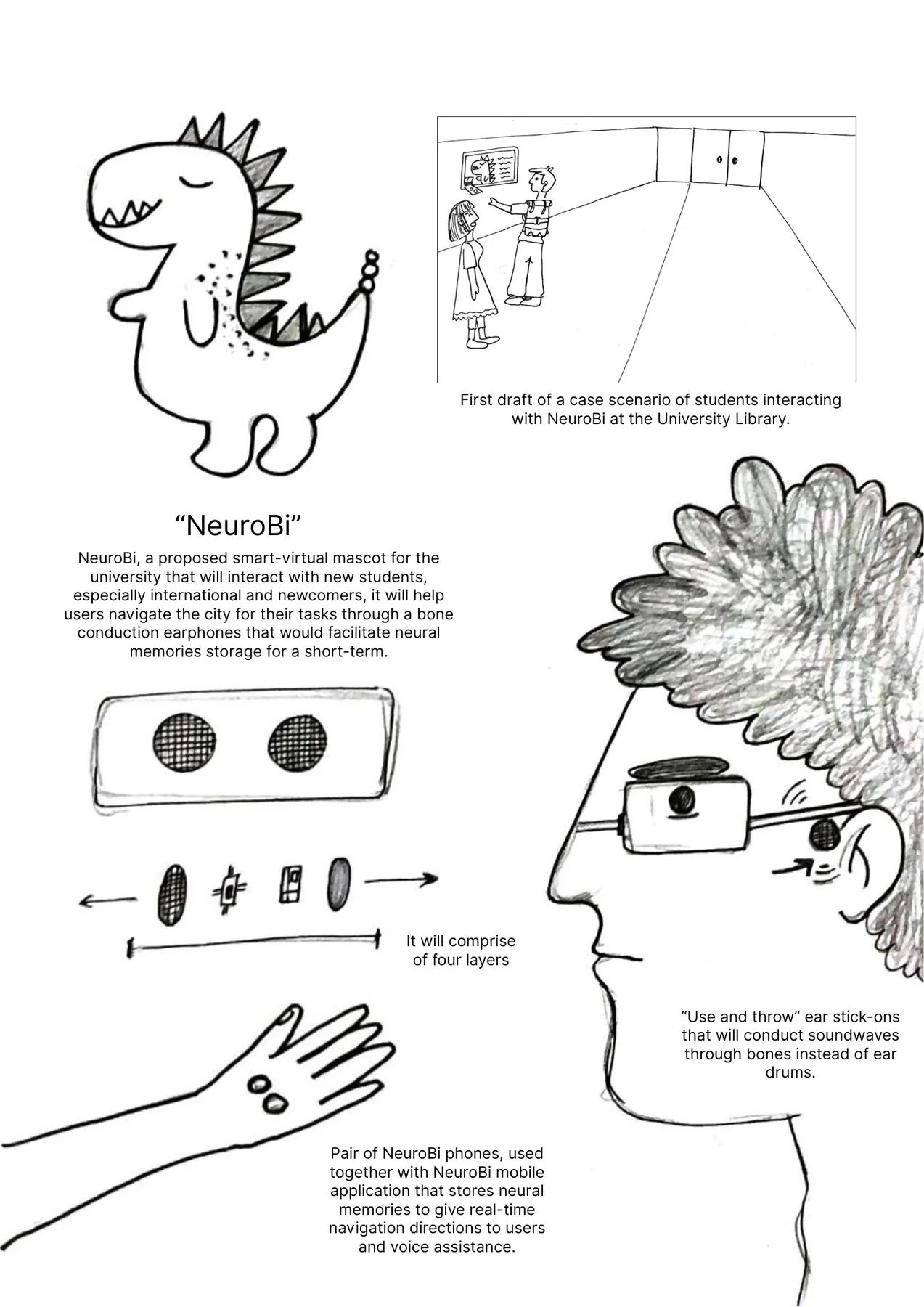
Early hand-drawn NeuroBi concept showing the mascot kiosk, ear stick-ons, phone and user journey
FROM A HAND SKETCH TO A DISTRIBUTED SYSTEM
ContextInternational student onboarding
TimeframeThe first 24 to 48 hours
SystemKiosk, wearable audio and AR
StatusIndependent speculative product vision

A city full of services, but no single journey through them

The burden of orientation is usually placed on the person who knows the least.

Arriving students must make decisions about registration, housing, identification, courses, transport and university life before they understand how the institution is organised. At Bauhaus-Universität Weimar, services are distributed across the city and communicate through different counters, websites, bulletin boards and mailing lists.

FRAGMENTATION

Useful information exists, but appears in separate systems.

The International Office, library, Language Centre, sports centre, dormitories and student-run spaces each have their own locations, schedules and procedures.

TRANSITION

The highest-stakes questions arrive before confidence does.

Newcomers may not yet know whom to ask, which language to use, when a counter closes, or which missing step will block the next one.

ACCESS

A mobile app cannot be the only doorway.

Download friction, unfamiliar interfaces, limited connectivity and administrative overload make another app an incomplete answer.

DESIGN QUESTION

What would it feel like to be truly supported as a newcomer?

NeuroBi reframes institutional infrastructure as a relational experience that begins at the station, not at the first successful login.
Lived experience as a starting point, not a universal answer

The concept was mapped through the places where confusion actually happens.

The project combined personal reflection, experience prototyping and situated walkthroughs. My own arrival experience and work in the student council made repeated infrastructure gaps visible, while informal conversations with other newcomers helped identify which problems recurred.

Autoethnography

Use the researcher's own route as evidence.

Memories of registration, housing, service hours, language and campus participation surfaced overlooked transitional moments.

Bodystorming and situated walkthroughs

Think with distance, timing and the body.

Walking between services helped test where support might appear and which modality would be least disruptive in each place.

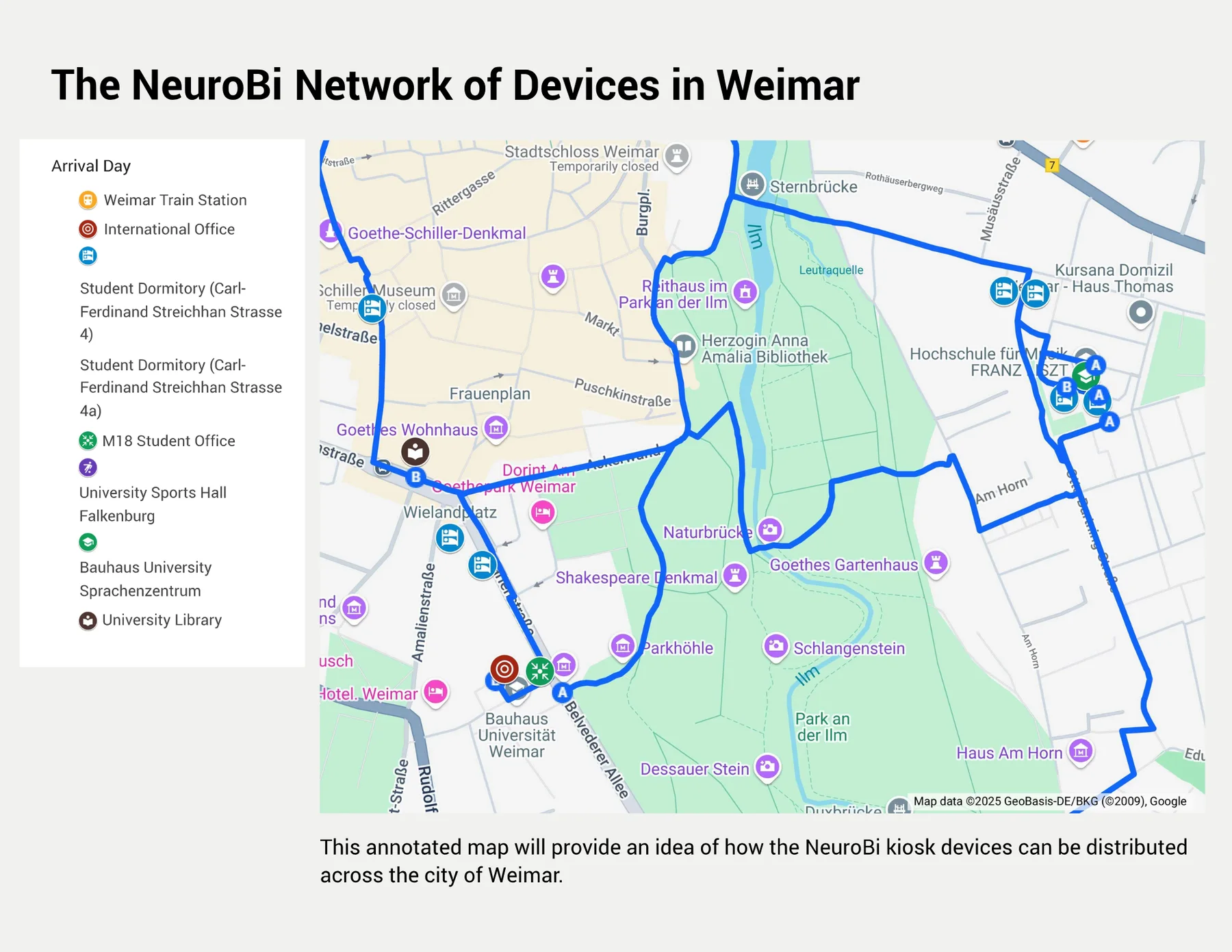
Annotated map of Weimar showing proposed NeuroBi devices across the station, campus and student services
The proposed NeuroBi network distributed across actual routes in Weimar.

One assistant, three visible layers

NeuroBi follows the student across physical, wearable and mobile touchpoints.

The mascot is a consistent social cue, but the project is not a single robot. It is a loosely coupled system designed to offer the right amount of help in different contexts.

Early NeuroBi product sketch
The first sketch connects a situated screen, physical dispensing action, wearable audio and a mobile memory layer.
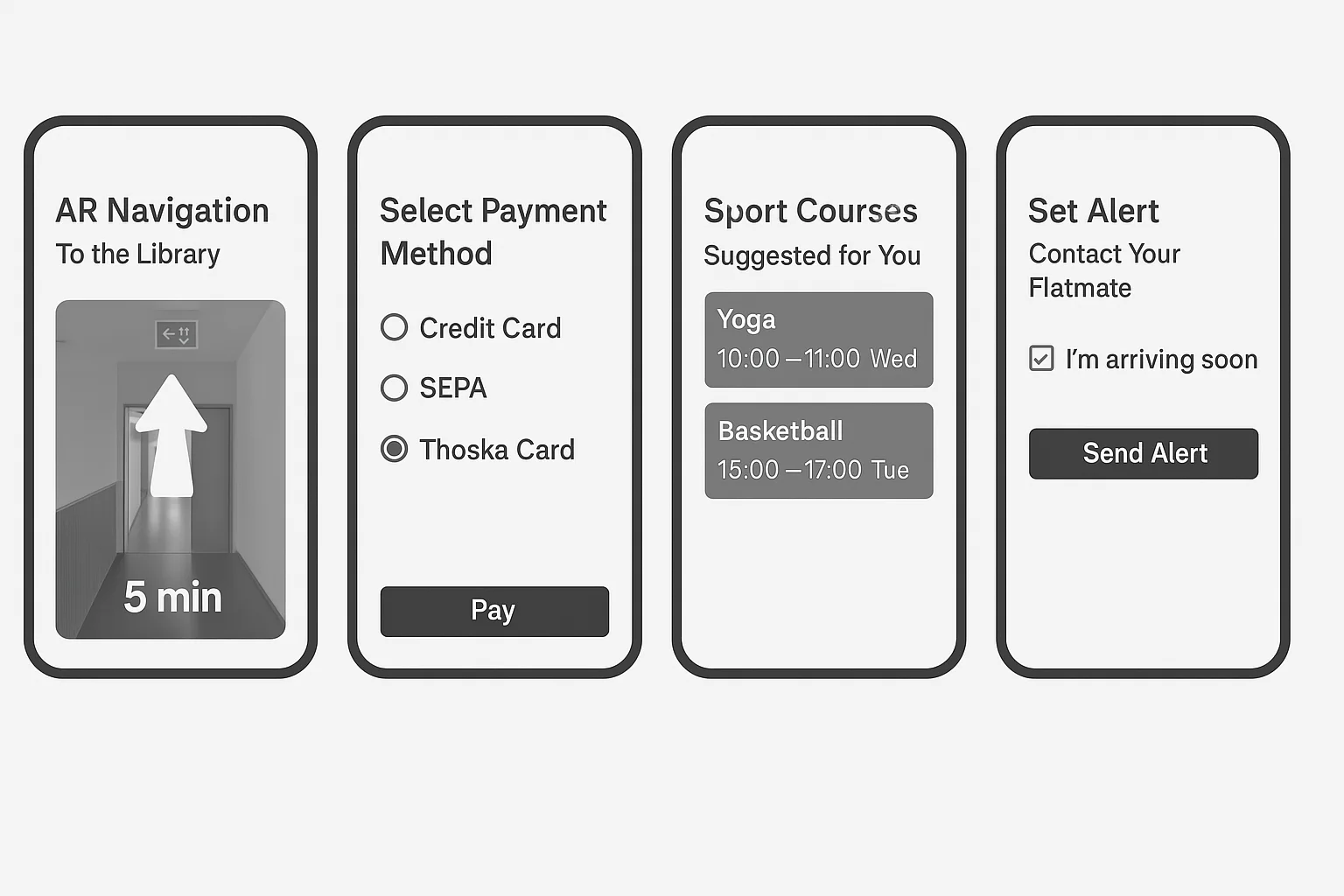
Four NeuroBi interface frames for navigation, payment, sports and art courses
Example interface states for navigation, payment and course discovery.
Physical layer01

Situated kiosks

Friendly touchpoints at the station, library, student offices and other high-impact locations. A lever dispenses private audio stick-ons.

Personal layer02

Bone-conduction ear stick-ons

A speculative, low-visibility audio interface for language-sensitive guidance without shared headphones or open speakers.

Continuity layer03

Mobile AR and voice

Navigation, reminders and contextual support continue between physical nodes without making the phone the only entry point.

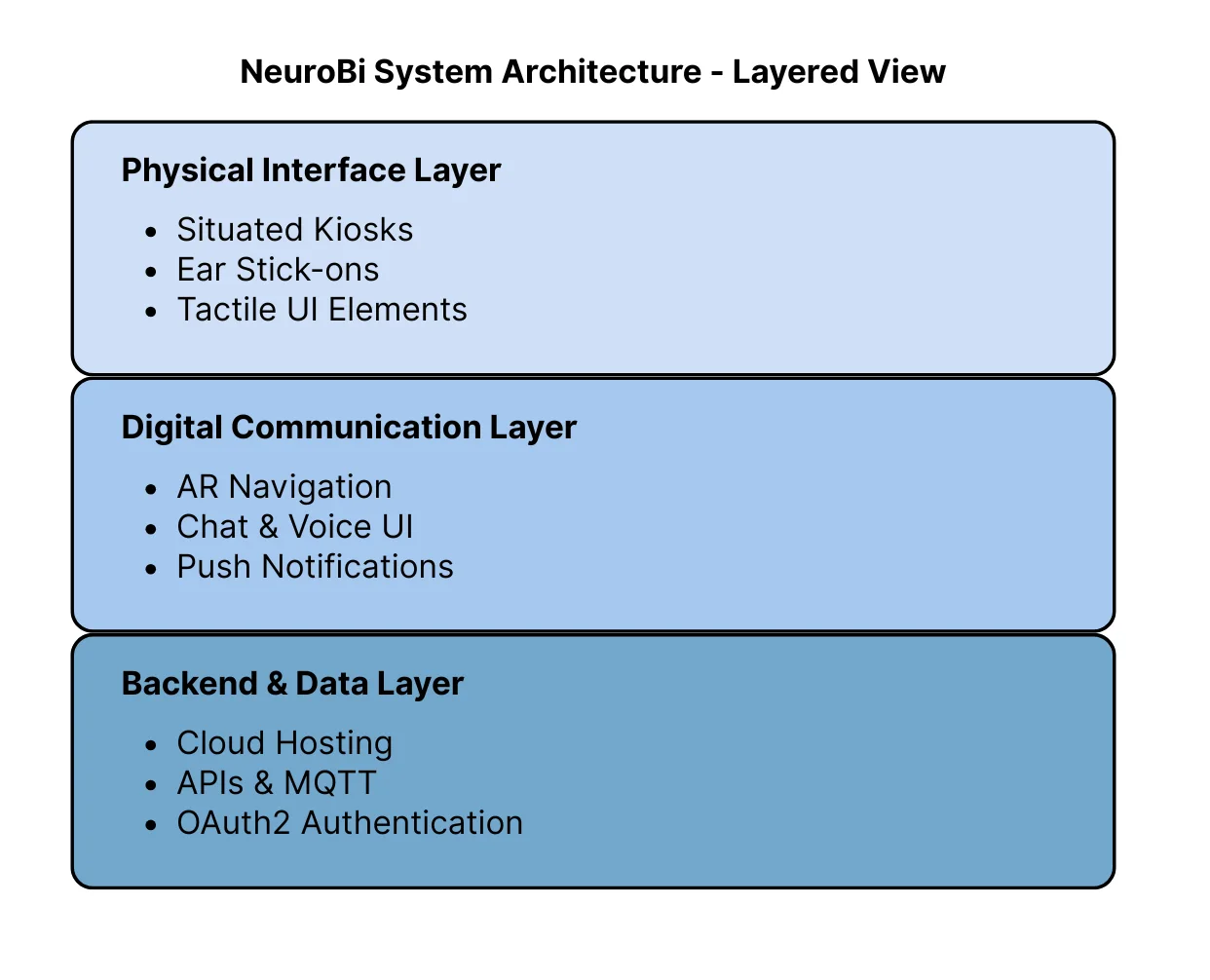
Layered NeuroBi architecture from physical interfaces through digital communication to backend data
Physical interfaces sit above communication and backend services, allowing local touchpoints to remain loosely coupled.

04 · The first 48 hours

Seven moments form one continuous onboarding journey.

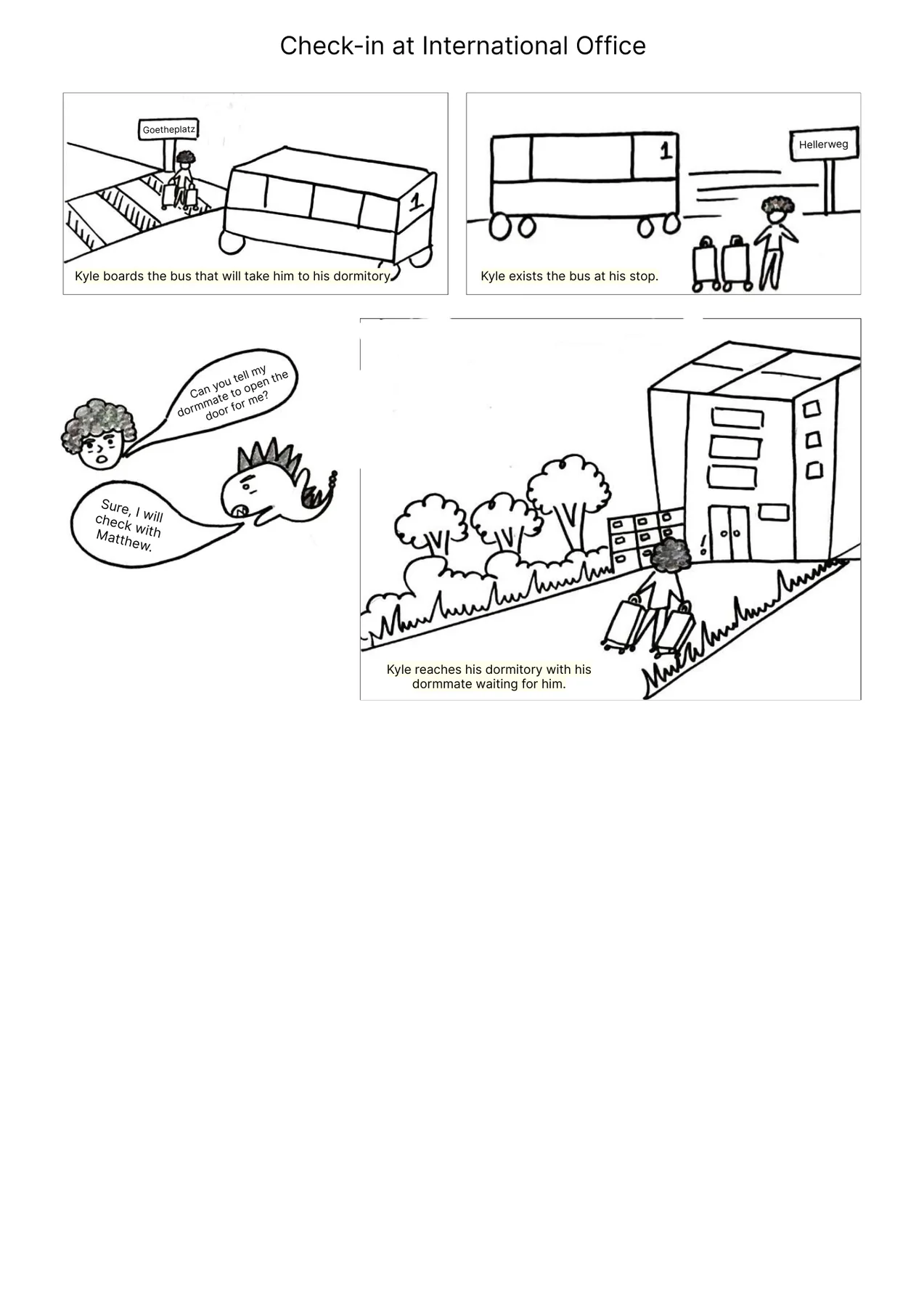
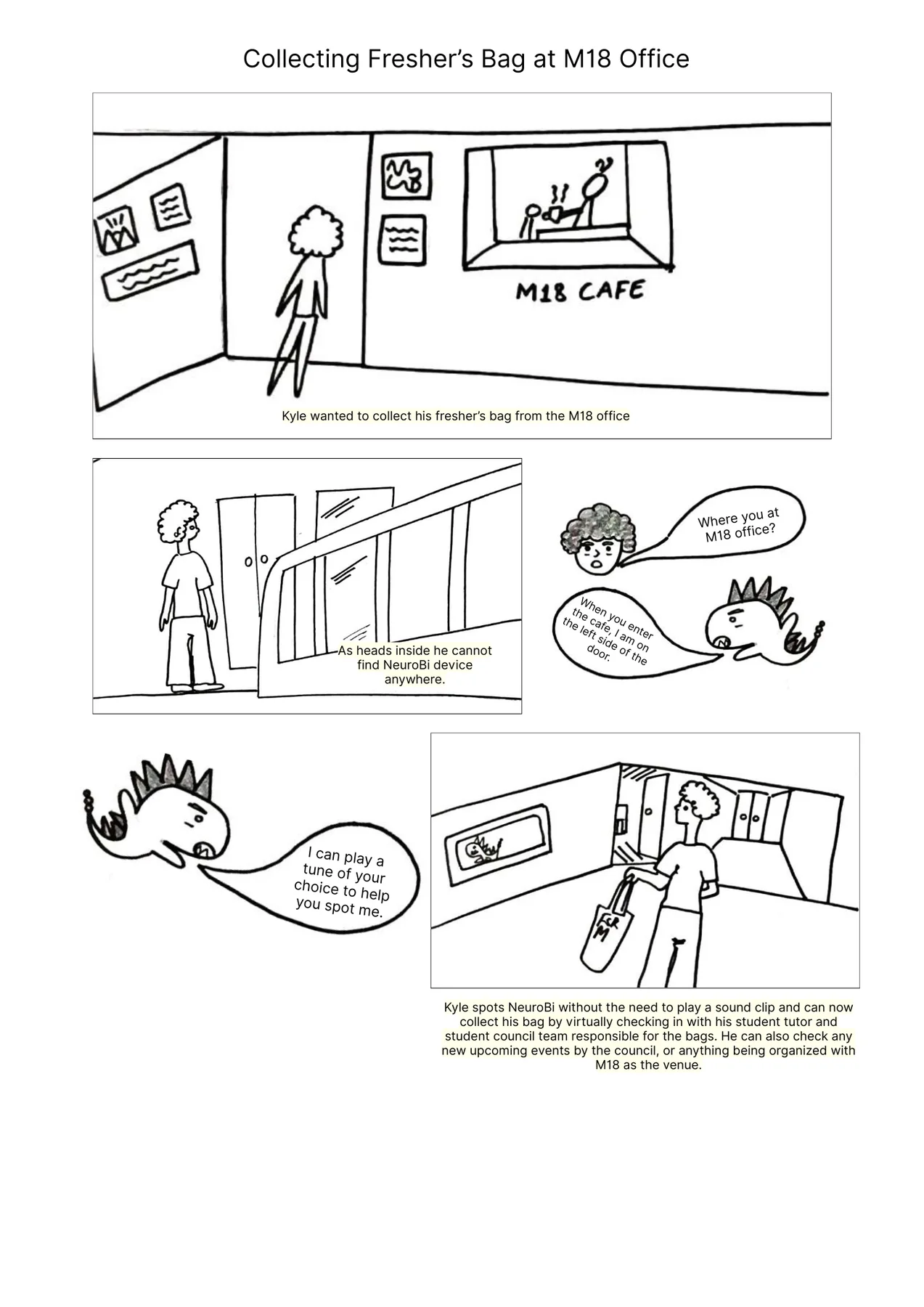
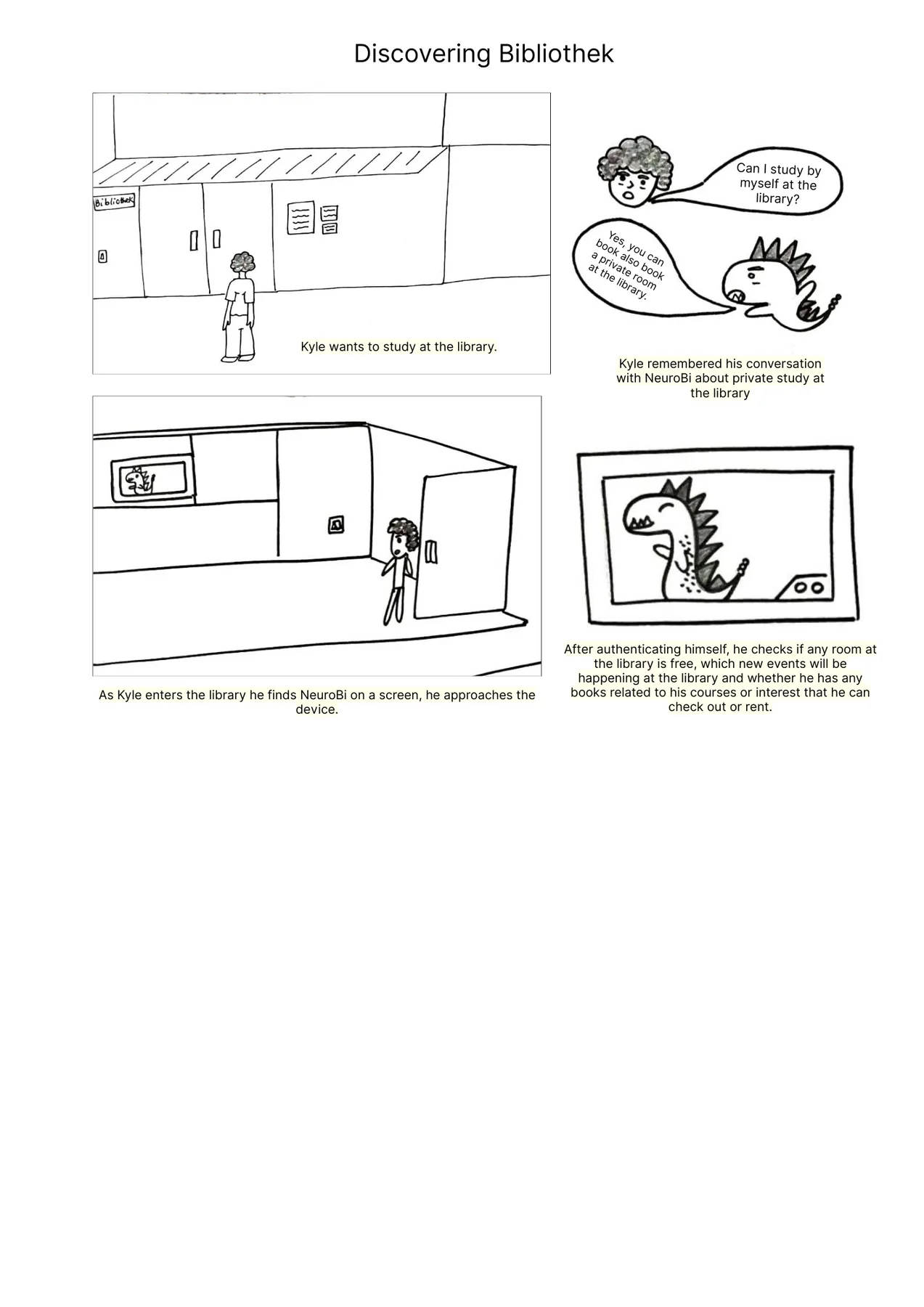
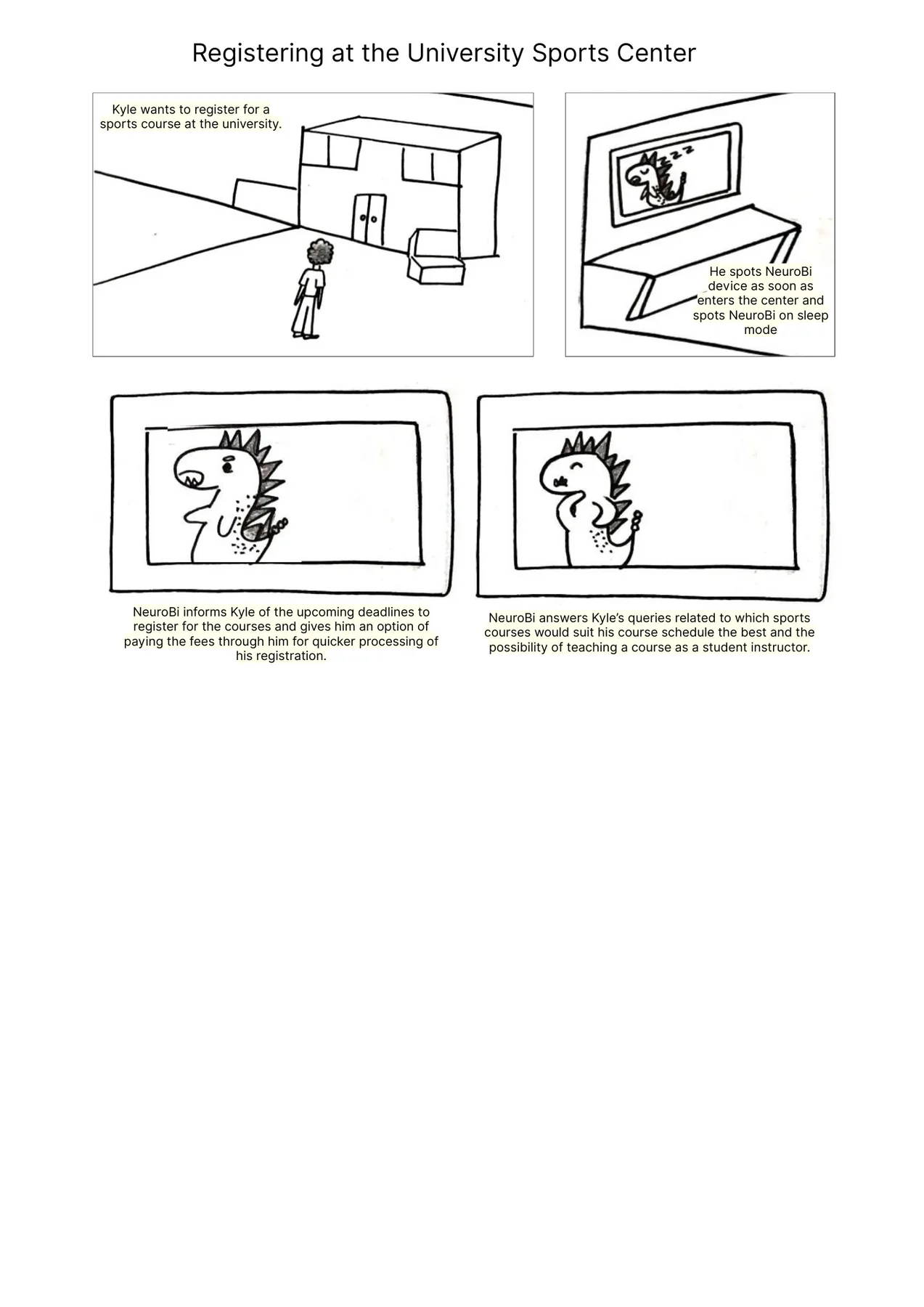
Kyle is a fictional international student created from autoethnographic insights and recurring newcomer experiences. The scenarios reveal how support changes with place rather than treating onboarding as a single transaction.

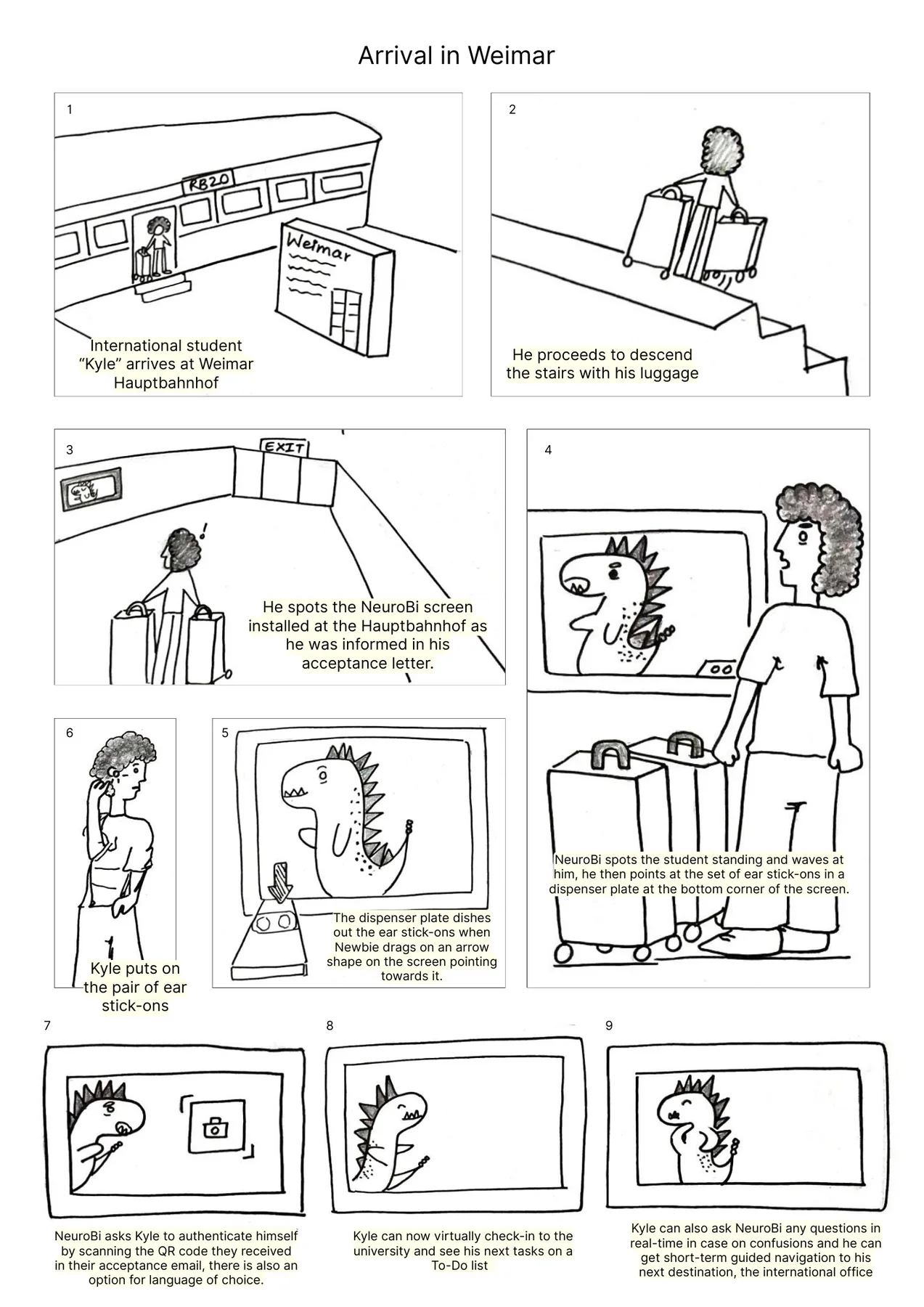
Storyboard of Kyle arriving at Weimar station and meeting NeuroBi
01 · StationAuthenticate, receive private audio and identify the next step.
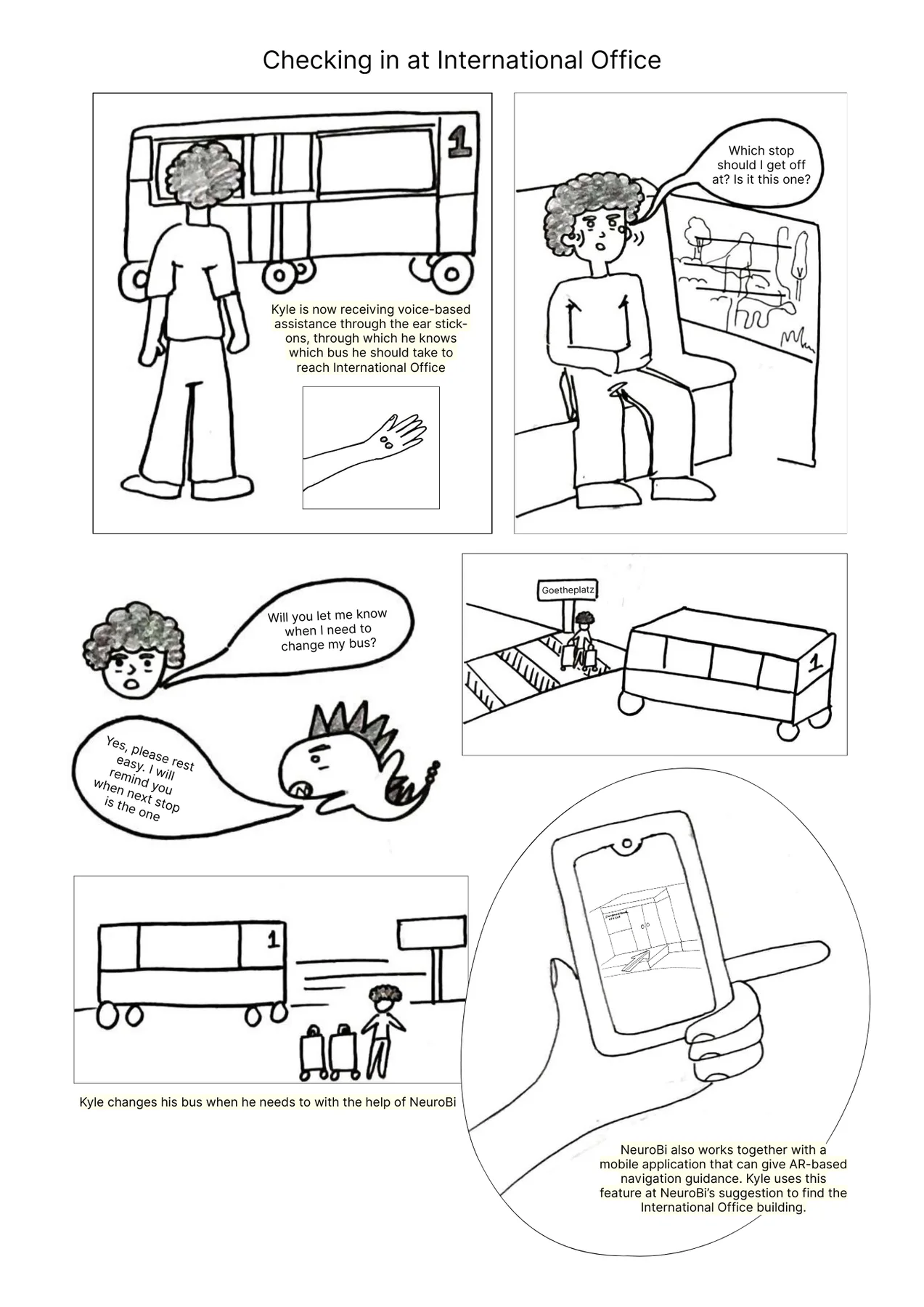
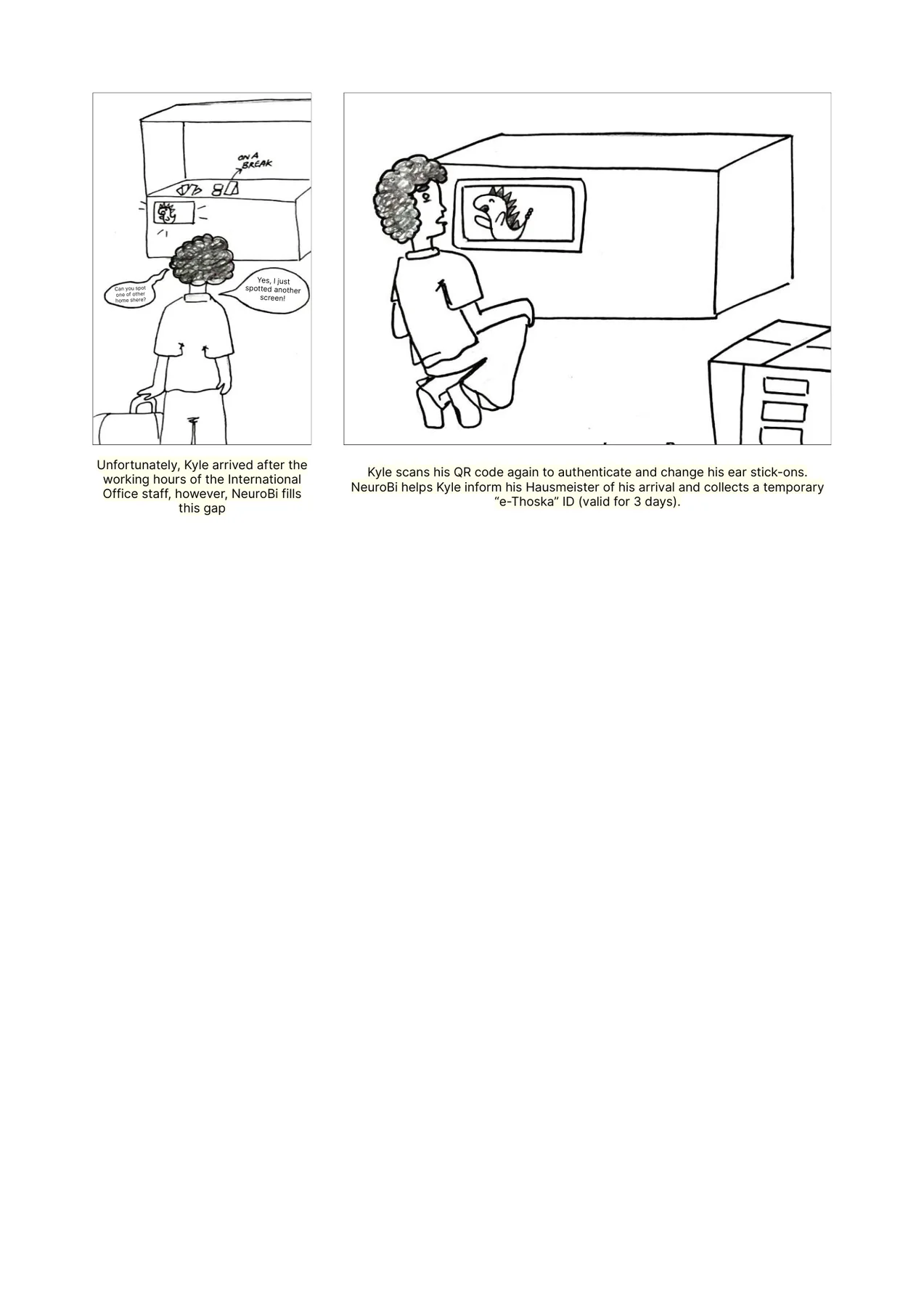
Storyboard of Kyle travelling to the International Office
02 · International OfficeNavigate transport and recover when the office is closed.
Storyboard of Kyle checking into the dormitory
03 · DormitoryNotify flatmates and enter with a temporary identity credential.
Storyboard of Kyle visiting the M18 student office
04 · M18Collect orientation material and discover student-run events.
Storyboard of Kyle exploring the university library
05 · LibraryFind study spaces, maps, events and relevant material.
Storyboard of Kyle registering at the university sports centre
06 · Sports CentreUnderstand deadlines, courses, payment and opportunities.
Storyboard of Kyle selecting a language course
07 · Language CentreMatch courses, placement tests and funding to the student's plan.

A system that should nudge, not nag

Support must remain calm, voluntary and subordinate to human care.

CALM

Respond when approached.

No ambient beeping, flashing or attention-seeking behaviour in shared spaces.

CONTEXTUAL

Answer the question of this place.

A library node should understand study rooms and books. A station node should understand arrival.

MULTIMODAL

Do not force one interface on every body.

Touch, visual storytelling, voice, private audio and AR provide different ways into the system.

SUPPLEMENTARY

Augment staff rather than replace them.

NeuroBi fills gaps during off-hours or high traffic while preserving routes to human assistance.

MODULAR

Start where the need is highest.

The network could begin at the station and library before expanding to other services.

TRANSPARENT

Make data use visible and optional.

Personalisation cannot become an excuse for invisible tracking across campus.

The concept is intentionally unresolved

The most interesting questions begin where the smooth journey ends.

NeuroBi is a research proposition, not a deployment-ready system. The report keeps its risks visible and identifies what would require co-design, institutional partnership and technical testing.

VISIBLE VS INVISIBLE

When should assistance stand out, and when should it recede?

Kiosks create clear approach points, while wearable and mobile layers risk becoming harder to inspect or control.

PERSONALISATION VS PRIVACY

Helpful reminders depend on data the institution must not quietly accumulate.

Opt-in controls, data minimisation and understandable retention policies would be foundational, not secondary.

VISION VS INSTITUTION

A coherent journey crosses departments that do not share one system.

Real implementation would require agreements across IT, services, student representation and administration.

DEPTH VS GENERALISATION

One researcher's experience can reveal friction without representing everyone.

Future work needs diverse students, accessibility perspectives and co-design across programs and languages.

Complete research report

Read the system, scenarios, literature and limitations.

The full paper documents the theoretical foundation, design rationale, architecture, seven use cases, critical discussion and references.

Open the report
NeuroBi is less a robot than a proposal for how an institution could meet someone halfway.

The project asks universities to treat onboarding as a connected spatial experience. Its contribution is the ecology: support that can appear at the station, travel quietly between buildings and step aside when human help is available.