Research

Questions with a life beyond one project.

Human-AI interaction, comic-based research methods, participatory design and experimental interfaces. This page separates published work, completed scholarship and ongoing research directions.

Research identity

HCI across conversation, participation and material interaction.

My research follows what happens when familiar interfaces stop behaving like forms and screens. I study conversational identity and suspicion, comics as participatory research interfaces, and quieter tangible or spatial ways of interacting.

ORCIDProfile link pendingIdentifier will be added after direct verification.
Google ScholarProfile link pendingPublication-level metadata is verified independently.

Completed scholarship

Clone Testing.

A complete master’s thesis, deployed study system and public project record.

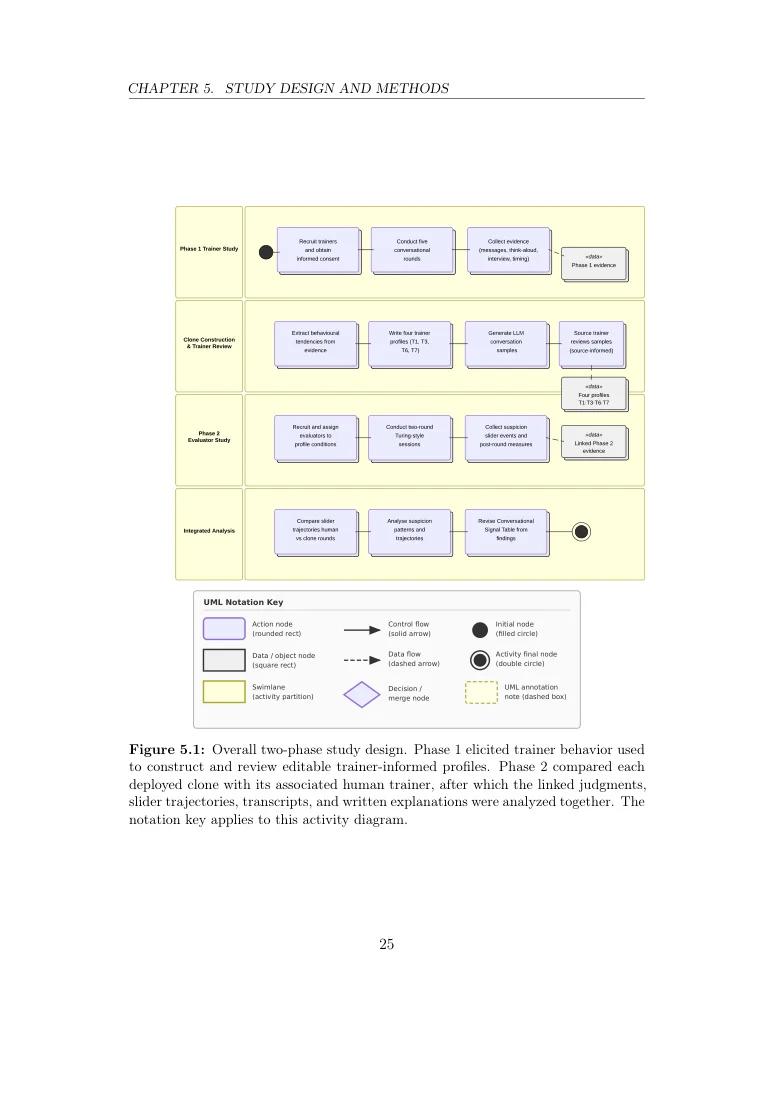
Two-phase Clone Testing study design

MASTER'S THESIS · SUBMITTED 5 OCTOBER 2026

Clone Testing: An Investigation of Trust and Suspicion in Identity Recognition During Human-Machine Dialogue

The study examined how people build, revise and explain judgments about whether a conversational partner is human or machine-generated. Its two-phase design connected persona training, editable clone profiles and live evaluation with continuous suspicion measurement.

Author
Shriya Singh
Programme
M.Sc. Human-Computer Interaction, Bauhaus-Universität Weimar
Referees
Prof. Dr. Benno Stein and Prof. Dr. Maria Wolters

Publication

Comicification.

The citation below follows the official Gesellschaft für Informatik record.

01

MENSCH UND COMPUTER 2025 · WORK IN PROGRESS

Comicification: Human-centered approach to data visualization and participant autonomy by redesigning surveys

Shriya Singh and Konstantina Marra

Mensch und Computer 2025 Workshopband. Gesellschaft für Informatik e.V., Chemnitz, Germany, 31 August to 3 September 2025.

DOI: 10.18420/muc2025-mci-wip-328

Research directions

Three connected lines of inquiry.

These are active directions rather than claims that every project is a formal publication.

01

Human and agent interaction

Trust, suspicion, identity detection, conversational repair and how people reason about artificial partners.

Follow Clone Testing
02

Comics as research interfaces

Sequential visual questions, participant autonomy, multimodality, public participation and research methods that can evolve beyond conventional forms.

Follow Comic Survey Lab
03

Tangible and spatial interaction

Peripheral communication, zero-interface interaction, AR narratives and systems that use movement, material and place.

Follow MudraMor